

 Facebook
 X
X
 Pinterest
 Copy Link
Should I Sell My Brookland, DC Home Now or Wait Until 2027?
Here’s the honest picture. District-wide, the average home is selling about 1.6% below list price, 32% of listings take a price cut, and market time runs around 57 days. That is not a market where sellers dictate terms. But mortgage rates have climbed to 7.03%, the Federal Reserve raised rates in September 2026 for the first time in more than three years, and no major forecaster currently expects a return below 6%. Waiting for 2027 is a bet
that the buyer pool gets stronger, and the available evidence points the other way.
The exception matters, though, and it’s a big one: if you’re holding a 3% mortgage and planning to buy again in the District, the arithmetic can flip entirely. I walk through that below.
Last updated: September 28, 2026.
A disclosure before I go further: I’m a listing broker, and I get paid when homes sell. Read what follows knowing that, and check the underlying data yourself — I’ve sourced all of it at the bottom.
Here’s the honest picture. District-wide, the average home is selling about 1.6% below list price, 32% of listings take a price cut, and market time runs around 57 days. That is not a market where sellers dictate terms. But mortgage rates have climbed to 7.03%, the Federal Reserve raised rates in September 2026 for the first time in more than three years, and no major forecaster currently expects a return below 6%. Waiting for 2027 is a bet
that the buyer pool gets stronger, and the available evidence points the other way.
The exception matters, though, and it’s a big one: if you’re holding a 3% mortgage and planning to buy again in the District, the arithmetic can flip entirely. I walk through that below.
Last updated: September 28, 2026.
A disclosure before I go further: I’m a listing broker, and I get paid when homes sell. Read what follows knowing that, and check the underlying data yourself — I’ve sourced all of it at the bottom.
Quick facts: the Brookland and Washington, DC market right now
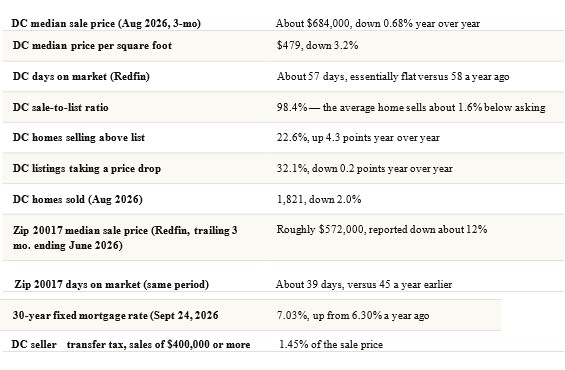
Three cautions on that table.
The Redfin day counts are Redfin’s own measure on Redfin’s own definitions. They are not the same thing as a Bright MLS median, and the two should never be set against each other.
The 20017 rows are a different period than the District rows — a three-month window ending in June, not August — because that’s the most recent zip-level data published. And zip 20017 is not Brookland: it also takes in Michigan Park, Queens Chapel and part of Woodridge.
Most important, neighborhood and single-zip medians are built on a handful of sales per month, and a few large or small transactions move them double digits. The reported 20017 decline of about 12%, and the various
Brookland medians floating between roughly $570,000 and $835,000 across different sources and periods,
should be read as noise around a roughly flat trend, not as a 12% loss on your house. The District-wide figures are far more reliable, and they show prices down less than one percent.
Is now a good time to sell a house in Brookland, DC?
It’s a workable time, not a great one, and being clear about that is more useful to you than optimism.
The District is what Redfin classifies as only somewhat competitive. The average home sells for roughly 1.6% under list, about a third of all listings take a price reduction before they sell, and market time is sitting near 57 days. That is a market where buyers have room to negotiate and are using it.
What’s on the seller’s side of the ledger is smaller but real. Sale-to-list actually improved slightly year over year, and the share of homes selling above list rose more than four points to 22.6%. The share of listings taking a price cut was essentially unchanged, down two-tenths of a point — no better and no worse. Market time in 20017 has tightened, running around 39 days against 45 a year earlier, though that’s a small-sample zip figure from an earlier window. Prices district-wide are close to flat rather than falling. And Brookland has structural
demand that some of the District’s softer pockets don’t: Red Line access at Brookland-CUA and Rhode Island Avenue, the Catholic University campus, Monroe Street Market, and a housing stock of bungalows and
rowhomes that buyers actively seek out.
So the picture is a slow, price-sensitive market in which prepared, correctly priced Brookland homes still transact within roughly six weeks of listing.
What happens to my buyer pool if I wait until 2027?
This is the question that actually decides the answer, and it’s not about prices. It’s about financing.
Freddie Mac’s 30-year fixed averaged 7.03% on September 24, 2026, up from 6.30% a year earlier. On
September 16, 2026, the Federal Reserve raised its benchmark rate for the first time in over three years, and the committee’s own projections pointed to the possibility of at least one further increase.
Here’s what that does to the person buying your house. Hold a buyer’s monthly principal-and-interest budget constant at roughly $3,900 with 20% down:
- At 30%: that payment supported a purchase price near $787,000
- At 03%: the same payment supports about $731,000
Same buyer, same budget, roughly $57,000 less house. (Illustrative only — 30-year fixed principal and interest at 20% down, excluding taxes, insurance, HOA and PMI. Your buyer’s actual qualifying amount depends on
their full debt-to-income picture.)
Forecasts don’t promise relief. As of September 2026, the Mortgage Bankers Association projects 30-year rates near 6.8% through mid-2027, and Fannie Mae has it around 6.8% near-term easing to about 6.7%. No major forecaster currently expects a drop below 6%. Those are projections and they get revised constantly — a few Fed participants do see cuts in 2027 — but “wait for rates to fall” has cost sellers money over the last twelve months rather than making it.
If rates hold or rise, your 2027 buyer is qualified for less than your 2026 buyer. In a market already running at 98.4% of list, that pressure tends to come out of your price. That’s a directional argument, not a forecast — rates could also fall, and if they do, the waiting seller is the one who benefits.
What’s the case for waiting until 2027?
Three arguments, and one of them is strong.
The strong one: you hold a low mortgage rate and you’re buying again locally. If you’re sitting on a 3% loan and you’d finance a comparable Brookland home at 7%, your monthly payment rises substantially even buying at the same price. On a 30-year fixed loan in the $500,000 to $600,000 range, that’s roughly $1,200 to
$1,500 more per month in principal and interest. No amount of favorable market timing offsets that. If you don’t have to move, this is often the reason not to.
The moderate one: spring traffic. March through May is the heaviest buyer-traffic window in most Mid-Atlantic markets. If your timing is fully flexible and your house needs work you can’t complete before winter, waiting for spring is reasonable. The offset is that every seller waiting for spring becomes your competition in spring.
The weak one: waiting for prices to recover. District prices are down less than one percent year over year.
There is no meaningful decline to recover from, and no forecaster is projecting a jump that would reward a year of holding costs, taxes and risk.
There’s also a genuine uncertainty worth naming rather than predicting: the District’s housing market is more exposed to federal employment and federal contracting than any other in the country. Changes there could push demand in either direction over the next year, and anyone who tells you confidently which way is guessing.
How much does it cost to sell a house in Brookland, DC?
This matters more than usual when you’re weighing “now versus later,” because transaction costs are the price of being wrong twice.
The District charges a deed transfer tax of 1.45% on sales of $400,000 or more, and by statute it’s the seller’s obligation, though the contract can allocate it differently. On a $700,000 Brookland sale, that’s about $10,150 in transfer tax alone. The buyer separately owes a 1.45% recordation tax. Add brokerage commission, title and settlement fees, any payoff, and any negotiated buyer closing-cost assistance. Rates and thresholds change and certain buyers qualify for reduced rates, so confirm current figures with your settlement company rather than relying on this page.
Ask for a written seller net sheet before you list. If you’re moving again inside two years, transaction costs on both ends rarely pencil out.
If anyone is renting from me, what do I have to do first?
This is the single most consequential thing to get right about selling in the District, and it’s the step out-of-state sellers most often miss.
Under the District’s Tenant Opportunity to Purchase Act, generally known as TOPA, a tenant of a housing accommodation has a right to receive an offer of sale and an opportunity to purchase before the owner sells, with statutory notice requirements and timelines that vary by the size of the building. The law has been
amended repeatedly — the 2018 single-family exemption narrowed what’s covered, and later changes adjusted it again — and the analysis turns on details like whether the unit is a single-family accommodation, whether there’s a separate basement or English-basement unit, and who was occupying it and when.
Brookland is exactly the kind of neighborhood where this comes up constantly: rowhouses with basement apartments, bungalows with a rented lower level, and houses near Catholic University that have had student tenants.
I am not going to tell you on a web page whether TOPA applies to your property, because getting that wrong can void a sale or expose you to damages. What I will tell you is that if anyone has been living in your house as a tenant — on a lease, month-to-month, or by handshake — you should talk to a DC real estate attorney before you sign a listing agreement, not after you have a contract. The cost of that conversation is trivial against the cost of getting it wrong.
How do I sell a Brookland home for the most money in this market?
In a 57-day, 98.4%-of-list market, execution is nearly everything.
Price from closed comps, not from asking prices. Your listing gets the largest audience it will ever have in its first ten days, when it surfaces as new inventory in every buyer’s saved search. A third of DC listings end up
cutting price, and in my experience most of those started too high and then chased the market down. Listed prices are opinions; closed prices are the evidence appraisers work from.
Pre-inspect. Brookland’s bungalows and rowhomes are old enough that knob-and-tube wiring, galvanized plumbing, aging sewer laterals, lead paint and basement moisture are routine findings. Buyers financing at
today’s rates have less cash cushion for surprises, and in my experience they discount unknowns more heavily than the repair would have cost. Knowing your issues first means you control the negotiation. Note that a pre-inspection doesn’t replace your DC disclosure obligations, and what you learn may become disclosable — worth discussing before you order one.
Have your documentation ready for the appraisal. With prices flat and price-per-square-foot down 3.2% district-wide, appraisal gaps are a common place for deals to fall apart. Assemble your permit records, improvement receipts and dates so the appraiser has complete information about the property. The appraiser
reaches an independent conclusion — the point is to make sure nothing about your house is invisible to them.
Consider a rate buydown instead of a price cut. A seller-paid temporary buydown targets the buyer’s
monthly payment, which at 7% is the number they’re actually shopping. Whether it costs you more or less than an equivalent price reduction depends on the loan size and structure, and lender and loan-program rules limit what’s allowed, so run both options side by side with a lender before choosing.
Market the specific features of the property and its location. Metro access, Monroe Street Market, the Metropolitan Branch Trail, walkability. In a market where buyers are being selective, the concrete reasons to choose your house need to be in the listing rather than left for a buyer to discover.
Frequently asked questions
Should I sell my Brookland, DC home now or wait until 2027?
For owners who know they need to sell within a year or two, listing sooner is generally the stronger position, because mortgage rates have risen to 7.03%, the Fed raised rates in September 2026, and no major forecaster projects a return below 6%. A higher-rate 2027 buyer is qualified for less. The main reason to wait is if you hold a low mortgage rate and plan to buy again locally.
Are home prices going down in Washington, DC?
Barely. The District’s median sale price was about $684,000 over the three months ending August 2026, down 0.68% year over year, with price per square foot down 3.2%. That’s flat, not declining. Neighborhood-level figures for Brookland and 20017 swing much more, but those are small-sample numbers.
How long does it take to sell a house in Brookland?
Redfin puts District-wide market time around 57 days, with zip code 20017 closer to 39 days in its most recent three-month window. Those are Redfin’s own measures and are not comparable to a Bright MLS median. Add
roughly 30 to 45 days for a financed settlement. Correctly priced homes move faster; about a third of DC listings end up taking a price cut.
Do I have to offer my house to my tenant before selling in DC?
Possibly. The District’s Tenant Opportunity to Purchase Act generally gives a tenant the right to receive an offer of sale and an opportunity to purchase before the owner sells, with notice requirements and timelines that vary by building size. The law has been amended several times and the analysis depends on specifics like whether
the property is a single-family accommodation and whether there’s a separate basement unit. If anyone has been renting from you, consult a DC real estate attorney before signing a listing agreement.
Will mortgage rates go down in 2027?
No major forecaster currently expects a drop below 6%. As of September 2026 the Mortgage Bankers
Association projects roughly 6.8% through mid-2027, and Fannie Mae projects about 6.8% near-term easing to 6.7%. The Federal Reserve raised rates in September 2026 and its projections pointed to the possibility of at least one more increase. Forecasts are revised frequently.
How much is the seller’s transfer tax in Washington, DC?
For sales of $400,000 or more, the DC deed transfer tax is 1.45% of the sale price and is the seller’s obligation by statute, though the contract may allocate it differently. On a $700,000 sale that’s about $10,150. The buyer separately owes a 1.45% recordation tax. Confirm current rates and any reduced-rate eligibility with your settlement company.
Is Brookland a seller’s market or a buyer’s market?
Closer to balanced, leaning buyer. The average DC home sells about 1.6% below list, 32% of listings take a price reduction, and market time is near 57 days. But 22.6% of homes still sell above asking, up more than four points year over year, and Brookland’s Metro access and housing stock support steadier demand than some softer parts of the District.
SOURCES
- Redfin Washington, DC housing market data, three months ending August 2026
- Redfin zip code 20017 market data, 2026
- Freddie Mac Primary Mortgage Market Survey, 24, 2026
- Federal Reserve FOMC decision and Summary of Economic Projections, 16, 2026
- Fannie Mae and Mortgage Bankers Association rate forecasts, 2026–2027
- DC Office of Tax and Revenue, deed transfer and recordation tax rates
- DC Code Title 42, Chapter 34 (Tenant Opportunity to Purchase Act) and subsequent amendments
This article is for general information and is not financial, tax or legal advice. Redfin figures are Redfin’s own measures on Redfin’s own definitions and are not comparable to Bright MLS medians. Neighborhood and zip-code medians are based on small sample sizes and are volatile month to month; the zip 20017 figures cover a three-month window ending June 2026, an earlier period than the District-wide figures. Payment and qualifying illustrations are 30-year fixed principal and interest only. Market data changes; figures reflect the most recent available as of September 28, 2026. Confirm transfer tax treatment with your settlement company, and confirm any tenant-purchase-rights obligation with a DC-licensed attorney.


