How Do I Commute from Laurel, MD to Washington, D.C. or Baltimore? MARC Camden Line vs. Driving I-95, BW Parkway & US-1
By Reggie Butler, Broker/Owner, CENTURY 21 Envision · Updated October 18, 2026
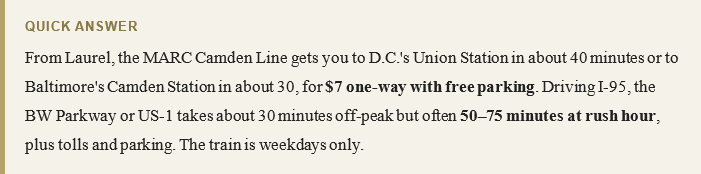
Laurel sits almost exactly halfway between Washington and Baltimore, which is a big reason buyers love it. You can work in either city and choose each day whether to ride or drive. Here’s how the two options compare.
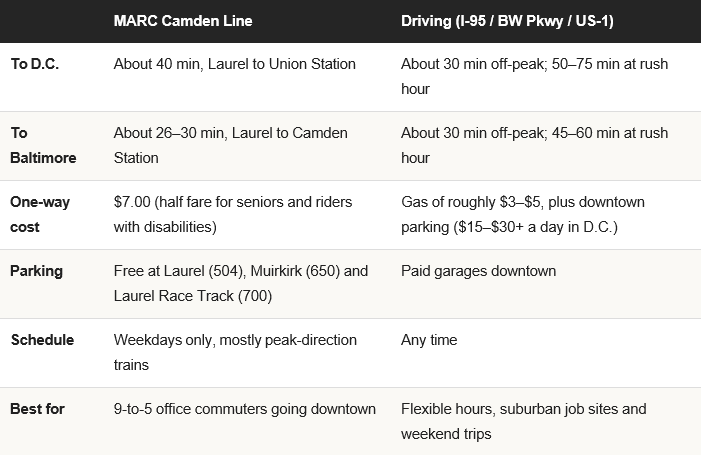
Train vs. car at a glance
Train times are from MARC schedules in effect since September 28, 2026. Drive times are typical ranges; real-time traffic varies day to day.
Option 1: Riding the MARC Camden Line
The Camden Line runs on CSX tracks between Washington Union Station and Baltimore’s Camden Station (next to Oriole Park), with Laurel in the middle. Two stations serve Laurel commuters:
Laurel station, 22 Main This is the historic 1884 B&O depot in Old Town Laurel. It has 504 free spaces, bike lockers and Metrobus and RTA bus connections.
Muirkirk station, 7012-B Muirkirk , Beltsville. It has 650 free spaces and is a good choice if you live in South Laurel or near Route 1.
New in fall 2026: Since September 28, MARC runs through trains (830 and 831) linking the Brunswick and Camden Lines. A morning train leaves Laurel at 7:30 a.m. and reaches Baltimore Camden at 7:59 a.m.
Option 2: Driving I-95, the BW Parkway or US-1
I-95 is the fastest route to Baltimore and the Beltway, but it’s heavily congested at peak times, especially from MD-198 to the Beltway (I-495).
The BW Parkway (MD-295) is the most direct route into D.C. It has no trucks, but it’s prone to crash delays and has few
US-1 has traffic lights all the way through College Park, but it’s a useful backup when the highways
US-29 serves the Columbia and Silver Spring side. It’s a good choice if you live in North Laurel or west of I-
Commuter checklist
Parking: All three Laurel-area stations have free parking. Lots fill on busy mornings, so plan to arrive before about 7:30 m.
Tickets: One-way is $7.00. The CharmPass app sells one-way tickets, 5-day, 7-day and 31-day passes, and CharmFlex 6- and 20-ride packs. Avoid paying cash on board, which adds $5.
Discounts: Seniors and riders with disabilities pay 50% Students can use the Student Saver program. Two children under 6 ride free with a full-fare adult.
Schedule: The Camden Line runs weekdays On weekends, use the Penn Line from BWI or New Carrollton.
Rush hours to avoid when driving: about 6:00–9:30 m. heading to D.C. and 3:30–7:00 p.m. heading home. Fridays are often the worst evenings.
Backup plan: If you miss the last train, the Penn Line runs later from Union Station to BWI and New
Check before you go: MARC Train Alerts at maryland.gov. For traffic, use the Maryland 511 app.
Frequently asked questions
Which is faster to D.C., the train or the car?
Off-peak, the car is a little faster. At rush hour the train usually wins, at about 40 minutes and much more predictable.
Is parking free at the Laurel MARC station?
Yes. Laurel, Muirkirk and Laurel Race Track all have free parking.
Does the Camden Line run on weekends?
No, it runs weekdays only.
Sources: Maryland Transit Administration (MARC fares, MARC parking details and Camden Line schedule changes effective September 28, 2026); MARC Camden Line fare chart; station details. Drive times are typical estimates. Confirm current schedules and fares at mta.maryland.gov before you travel.
What Is the Average Home Price in Prince Frederick, MD 20678, and How Does It Compare to Northern Calvert County?
By Reggie Butler, Broker/Owner, CENTURY 21 Envision · Updated October 18, 2026
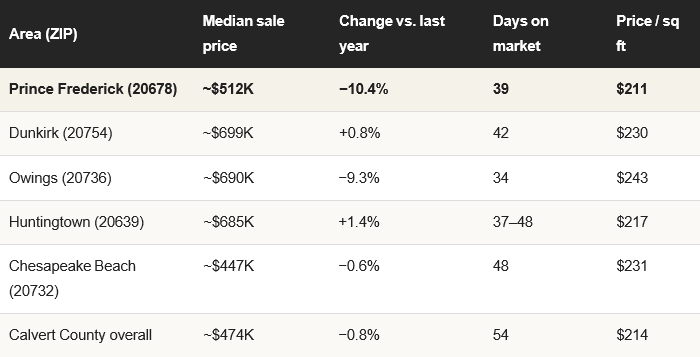
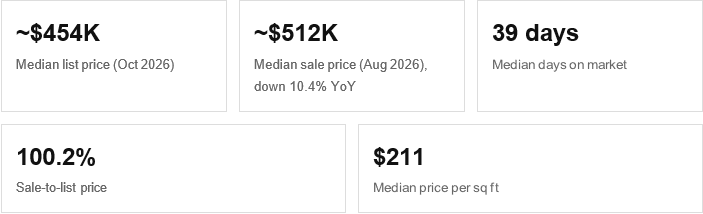
Prince Frederick 20678 market snapshot
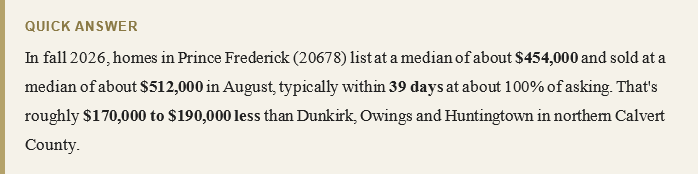
About 45 homes sold in 20678 in August 2026, and the market is still rated “very competitive.” Well-priced homes tend to sell at or near asking. Prices have cooled from last year’s peak, though, so buyers have a bit more room to negotiate than they did in 2025.
Why do the “average price” numbers differ from site to site? Listing sites measure different things. List prices show what’s for sale now; sale prices show what actually closed. One month’s mix can swing the numbers too: a few large homes on acreage push the median up, and a run of
townhome sales pulls it down. For pricing a specific home, a comparative market analysis is more reliable than any single headline number.
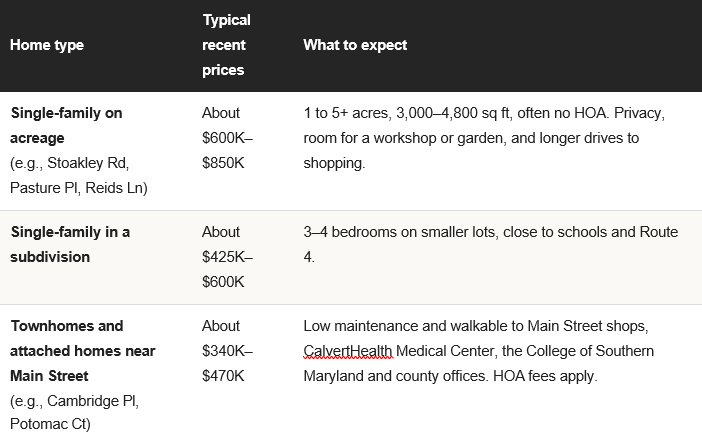
What you get for your money: acreage vs. townhomes
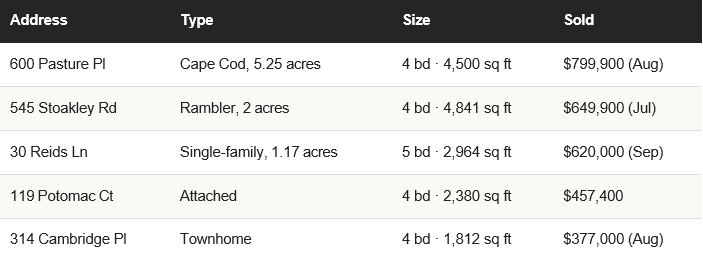
Price ranges are based on Prince Frederick sales from July to September 2026.
Recent sales in 20678
How Prince Frederick compares to Northern Calvert County
Redfin, August–September 2026. Monthly medians in small ZIP codes can swing, so treat these as a snapshot.
What the comparison tells you
Northern Calvert costs Dunkirk, Owings and Huntingtown sit closer to Washington, D.C., Andrews and Annapolis commutes, and they have more large, newer single-family homes. That puts their medians near $700,000.
Prince Frederick gives you more house per At about $211 per sq ft, it’s one of the better values in the county, and it’s the county
seat, with the hospital, college and most shopping.
Chesapeake Beach is the Its lower median reflects smaller bayside homes, townhomes and condos, not lower demand. Its price per square foot ($231) is higher than Prince Frederick’s.
Prince Frederick homes sell fast. At 39 days, they move quicker than the county average of 54
Frequently asked questions
Is now a good time to buy in Prince Frederick?
Prices are about 10% lower than a year ago, and more homes are on the market, so buyers have more choice than they’ve had in years. Well-priced homes still sell near asking, so it pays to be pre-approved and ready to move.
Is it cheaper to live in Prince Frederick than Dunkirk or Owings?
Yes. Median sale prices are roughly $170,000 to $190,000 lower, and at a 6.5–7% mortgage rate that’s often $1,100 or more a month in principal and interest.
What’s my Prince Frederick home worth?
It depends on lot size, condition and whether it’s attached or detached. A free comparative market analysis will give you a real number.
Sources: Redfin housing market data for ZIP codes 20678, 20754, 20736, 20639 and 20732 and for Calvert County (August–September 2026); Movoto 20678 listing data (October 2026); and Redfin recently sold listings for Prince Frederick. This information is believed accurate but is not guaranteed. Market data changes monthly.
Metro Centre at Owings Mills: Amenities, Housing Options and Transit Access
By Reggie Butler, Broker/Owner, CENTURY 21 Envision · Updated October 18, 2026
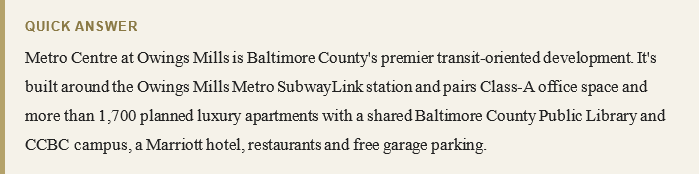
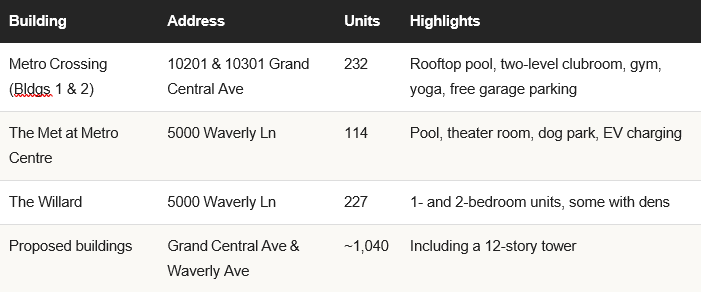
Built on the former Owings Mills Metro parking lots off I-795, Metro Centre is a roughly $220 million mixed-use neighborhood where you can live, work, study and catch the train without getting in a car. Here’s what’s there today and how it compares to traditional single-family living nearby.
Transit access
Metro SubwayLink: Owings Mills is the end of the Trains run every 8–11 minutes on weekdays and every 15–20 minutes on weekends, making 14 stops through downtown Baltimore to Johns Hopkins Hospital.
MTA buses: Route 87 (to Glyndon) and Route 89 (to Reisterstown Plaza).
Driving: I-795 is right there, with quick connections to I-695 and I-
Parking: Two free public garages (2,865 and 2,089 spaces), both with EV
Amenities
Library and college
The 80,000 sq ft Owings Mills Branch of the Baltimore County Public Library shares a building at 10300 Grand Central Ave with a 40,000 sq ft Community College of Baltimore County (CCBC) campus focused on workforce training and lifelong learning.
Dining and shopping
Eggspectation, World of Beer, Barrel & Vine, Hook & Reel, Suya Spot Nigerian Grill, Curry & Spice, Toastique, KungFu Tea and more. Fitness and services include Title Boxing Club, Club Pilates, Zero Latency VR and Metro Pharmacy.
Hotel and events
The 229-room Marriott Owings Mills Metro Centre has The Tillery restaurant, a Starbucks and a 6,240 sq ft ballroom. An Element by Marriott is planned for 2027. The Plaza hosts concerts, outdoor movies, farmers markets and seasonal festivals.
Office
Metro Office II (142,000 sq ft) houses firms such as BDO USA, CBIZ, Gannett Fleming and Carrington Mortgage, with more office buildings proposed.
Housing options at Metro Centre
Typical rents (Metro Crossing, fall 2026): one-bedrooms from about $1,760 (712 sq ft) and two-bedrooms about $2,060–$2,226 (873–1,118 sq ft). There’s a $350 amenity fee at move-in and $45 a month per pet. Dogs must be under 75 lbs, and breed restrictions may apply.
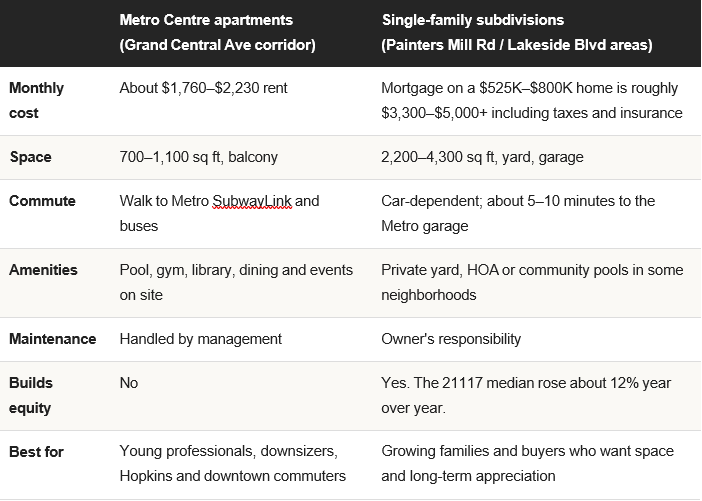
TOD apartment living vs. a single-family home nearby
Owings Mills (21117) market, August 2026: the median sale price was about $420,000, up 12% from a year earlier. Homes sold in a median of 35 days at 100.7% of list price, and the market is rated “very competitive.” Townhomes in the area often sell for about $275,000–$385,000, a
middle step between renting and a detached home.
Frequently asked questions
Is Metro Centre walkable?
Yes. Apartments, the library, restaurants, the hotel and the plaza are all within a few minutes’ walk. The Metro platform is across I-795, connected by the station.
Is parking free?
Yes. Both public garages are free, and Metro Crossing includes garage parking for residents.
Can I buy rather than rent at Metro Centre?
The residential buildings are rentals. If you’d rather own, nearby townhomes and single-family neighborhoods let you build equity while staying minutes from the Metro.
Sources: metrocentreom.com (Explore page), Wikipedia (Metro Centre at Owings Mills), Apartments.com listing for The Apartments at Metro Centre, The Met at Metro Centre amenities page, and Redfin 21117 housing market and recent sales data (August–October 2026). Rents, fees and availability change, so confirm with each property.
Cosca Regional Park & Clearwater Nature Center: Amenities, Pavilion Rentals and Trail Rules
By Reggie Butler, Broker/Owner, CENTURY 21 Envision · Updated October 18, 2026 · Clinton, MD
If you live in Clinton, or you’re thinking about buying a home in southern Prince George’s County, Cosca Regional Park is one of the area’s best everyday perks. It’s run by the Maryland-National Capital Park and Planning Commission (M-NCPPC), and much of its land is still forest. Here’s what’s there, what it costs, and the rules to know before you go.
Park highlights at a glance
Amenities at Cosca Regional Park
The lake and boat rentals
Cosca Lake is the park’s centerpiece. You can fish from the shoreline, and paddle boats are rented from the boathouse during the warmer months. Anyone 16 or older needs a valid Maryland fishing license.
Camping
The campground has about 25 sites for tents and RVs. Every site has water, a picnic table and a fire ring, and a handful have electric hookups. There’s a shower house and a dump station. Reservations are online only (there’s no on-site check-in), with a limit of six campers and one camping unit per site and a two-week maximum stay. The roads are narrow, so large RVs may have trouble.
Sports and recreation
The park has outdoor tennis courts and the year-round Cosca Tennis Bubble, a concrete skate park with a bowl, ramps and rails, baseball and softball fields, volleyball courts, horseshoe pits and several playgrounds.
Clearwater Nature Center
Inside the park at 11401 Thrift Road, Clearwater Nature Center is free to visit. Kids love the live animals (reptiles, amphibians, fish and birds), the Fossil Cave, the indoor turtle pond and the outdoor birds-of-prey habitat. Outside there’s a nature playground, a sensory path and a butterfly garden.
Programs: Animal Encounters, Family Campfires, Twilight Hikes, Wild Reading story times, a Home School Nature Club, Scout badge programs and a Lapidary Club for rock cutting and jewelry making
Rentals: Auditorium $70/hour (residents) or $91/hour (non-residents). Three-hour birthday packages are $200/$260, or $240/$312 with a
30-minute animal encounter.
Upcoming at Clearwater (fall 2026)
Open Carving Days, Oct 19–30, 11 m.–5 p.m. Free.
Wild Reading: Nature Storytime, Oct 21, 11 m.–noon. $6 for non-residents, less for residents.
Family Discovery Hike, Oct 25, 10–11:30 m. $5 for residents, $7 for non-residents.
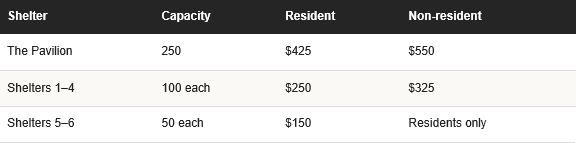
Pavilion and picnic shelter rentals
Booking rules
Reserve online through a Parks Direct account at com.
Book at least 72 business hours in
Pay the rental fee plus a $100 security deposit.
The renter must be at least 21. Resident rates require proof of Prince George’s or Montgomery County
Permits run 10 a.m.–7 p.m., seven days a
No refunds or rescheduling for rain or other weather.
Not allowed at shelters: amplified sound or bands, moon bounces, dunk tanks, pony rides, generators or propane, electricity hookups and selling merchandise.
Questions: Park Permits Office, 301-699-
For something smaller, Cosca also offers Posh Picnics: two-hour, styled picnic setups for 4 to 12 guests, from $250 (residents).
Trail rules and tips
Cosca’s trail network is five color-coded loops (red, blue, purple, orange and green), each about 1 to 2 miles, that link together through the forest. Trails are shared by hikers, mountain bikers and horseback riders.
Dogs must be on a leash at all times, and please clean up after
Stay on marked trails, and yield to horses. Bikers yield to
Visit during daylight hours unless you’re registered for an evening program like a Twilight
Carry out your trash. Alcohol is not permitted in the campground or at nature center
Natural-surface trails get muddy after rain, so wear sturdy
Frequently asked questions
Is there an entrance fee at Cosca Regional Park?
No general entrance fee is listed, and Clearwater Nature Center is free. You pay for campsites, shelter and pavilion permits, boat rentals and some programs.
How much is the pavilion at Cosca Park?
$425 for residents and $550 for non-residents, plus a $100 security deposit. It holds up to 250 people.
Are dogs allowed?
Yes, on a leash, including on the trails and in the campground.
Can I camp overnight?
Yes. There are about 25 sites, reserved online only, with up to six campers per site and a two-week maximum stay.
Sources: M-NCPPC Department of Parks and Recreation (pgparks.com) pages for Louise F. Cosca Regional Park and Clearwater Nature Center, checked October 2026. Campground details come from recent visitor reports. Fees, hours and events can change, so confirm with the park before you visit.
What Permits and Historic Approvals Do You Need to Add Solar Panels or Renovate a Home in Old Town Alexandria vs. Georgetown?
By Reginald “Reggie” Butler Jr., Broker/Owner, CENTURY 21 ENVISION | Updated October 2026 | 7-minute read
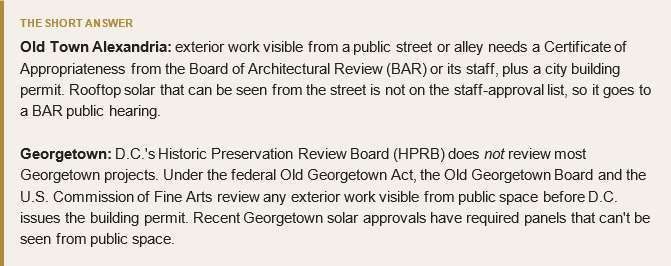
Old Town Alexandria and Georgetown are two of the most protected historic neighborhoods in the country. Buying there means a beautiful house, but also an extra layer of review before you change anything the public can see. The rule of thumb in both places: if it’s visible from the street, plan for historic review and a building permit. If it isn’t, the process gets much simpler.
Old Town Alexandria: the Board of Architectural Review (BAR)
The BAR is a seven-member board appointed by Alexandria City Council. It reviews exterior changes in the Old and Historic Alexandria District (created in 1946), the Parker-Gray District, and individually designated
100-year-old buildings.
Two kinds of approval
Certificate of Appropriateness (COA): needed for new construction and exterior alterations visible from a public street, alley, or other public way. Permit to Demolish/Capsulate: needed to demolish or cover more than 25 square feet of existing material — even if no one can see it. If a project needs both, they’re filed as two separate applications in the city’s APEX permit portal.
Three levels of review
Some work needs no BAR approval at all (work not visible from the public way, storm windows, plantings, routine maintenance). A long list of common items can be approved by BAR staff, usually in under five business days — for example rear or side fences up to 6 feet, minimally visible HVAC units, EV chargers, in-kind roof replacement, small skylights on non-street sides, and sheds up to 65 square feet. About three of every four applications are approved by staff. Everything else goes to a public hearing.
Solar panels in Old Town
Virginia law lets homeowners install rooftop solar by right, but still subject to local historic-district rules. In Alexandria, solar that is visible from the public right-of-way needs BAR approval at a hearing; it is not on the staff-approval list. The BAR’s solar guidelines (updated July 2025) call for panels that are minimally visible and low-profile, mounted close to the roof slope, placed on secondary or accessory structures where feasible, and within zoning height and setback limits. Panels that can’t be seen from the public way don’t need BAR review — confirm that with Preservation staff first.
Timing and fees
The BAR meets the first and third Wednesday of each month (no August meetings). A complete application is due about five weeks before the hearing. Current residential fees include $110 for a staff approval and $135 for alterations that add no floor area. BAR approval does not replace your building permit from Code Administration, which is also filed through APEX.
Georgetown: the Old Georgetown Board and Commission of Fine Arts
Georgetown is the exception to how historic review works everywhere else in D.C. The Old Georgetown Act of 1950 requires D.C. to send permit plans for building, altering, or demolishing anything visible from a public street to the U.S. Commission of Fine Arts (CFA), a federal agency. The CFA’s three-member Old Georgetown Board (OGB) does the detailed review. A separate HPRB application isn’t needed.
What needs review
Exterior changes visible from public space — including rear elevations, since staff check visibility in person and don’t count trees or shrubs as screening — plus demolition, new fences, storefronts, and signs. Minor repairs, repointing, storm windows, and underground utilities are exempt.
How the process works
You file your building permit application with D.C.’s Department of Buildings first, then email the OGB referral form and a combined PDF to D.C.’s Historic Preservation Office (HPO) at least three weeks before the OGB meeting. The OGB meets monthly, usually the first Thursday (no meetings in January or August). Routine projects go on a consent calendar and you don’t need to attend. Review is final when the full Commission of Fine Arts approves the OGB’s recommendations, about two weeks after the OGB meeting. HPO then clears the permit.
Solar panels in Georgetown
The OGB has no separate published solar policy. Recent approvals (for example, two rooftop solar permits in June 2025) were conditioned on the panels not being visible from public space, confirmed with mock-ups, with conduit kept to the rear. Plan for a low, hidden array on a flat or rear roof.
How HPRB works in the rest of D.C.
Outside Georgetown, D.C.’s historic districts (Capitol Hill, Dupont Circle, and others) are reviewed by HPO staff and the nine-member Historic Preservation Review Board, which meets monthly, usually the fourth Thursday. HPO staff approve minor work the same day or within about five business days; board cases take 30–60 days. D.C.’s solar guidance for those districts prefers secondary roof slopes and allows front slopes when needed if the panels are low-profile, flush with the roof, and set back from edges and ridges.
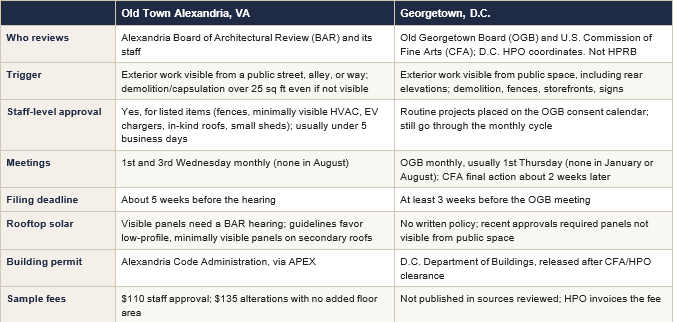
Side-by-side comparison
Step by step: how to check historic district maps in both jurisdictions
Step 1: Alexandria: open the Historic Preservation Map Viewer
Go to the City of Alexandria’s Historic Preservation Map Viewer (geo.alexandriava.gov, “historicpreservationviewer”). It shows the Old and Historic Alexandria District, the Parker-Gray District, and designated 100-year-old buildings.
Step 2: Alexandria: search the address and read the layers
Type the property address and check whether the parcel falls inside a local historic district boundary. Use the local district layers, not the National Register boundaries, which are different and don’t trigger BAR review.
Step 3: Alexandria: confirm with Preservation staff
Email preservation@alexandriava.gov or call 703-746-3833 to confirm the district and ask whether your project is staff-approvable. Ask about visibility before you design solar or an addition.
Step 4: D.C.: look up the address in PropertyQuest
Enter the address at propertyquest.dc.gov, the Office of Planning’s tool that shows historic district and landmark status for each lot.
Step 5: D.C.: check zoning on the D.C. Zoning Map
Open maps.dcoz.dc.gov and search the address to see the zoning district, which controls height, lot coverage, and setbacks for additions and solar mounting.
Step 6: D.C.: confirm whether Old Georgetown Act review applies
The Old Georgetown district runs roughly from Rock Creek Parkway (east) to Archbold Parkway (west), and from the Potomac River (south) to Dumbarton Oaks Park, Whitehaven Parkway, 35th Street and Reservoir Road (north). If you’re inside it, contact OGB staff at the Commission of Fine Arts (202-504-2200, georgetown@cfa.gov).
Frequently asked questions
Does the D.C. Historic Preservation Review Board review projects in Georgetown?
Generally no. Georgetown is governed by the Old Georgetown Act, so the Old Georgetown Board and the U.S. Commission of Fine Arts review visible exterior work. D.C.’s Historic Preservation Office coordinates the filing and permit clearance, and a separate HPRB application isn’t needed.
Can I put solar panels on a house in Old Town Alexandria?
Yes, but panels visible from a public street, alley, or way need BAR approval at a public hearing. The BAR’s guidelines favor low-profile panels mounted close to the roof on secondary or accessory roofs. Panels not visible from the public way don’t need BAR review. You also need a building permit.
Can I put solar panels on a house in Georgetown?
Often yes, if they’re hidden. The Old Georgetown Board has no written solar policy, but recent approvals were conditioned on panels not being visible from public space, confirmed with mock-ups.
How long does historic review take?
In Alexandria, staff approvals usually take under five business days; hearing cases follow the BAR’s
twice-monthly schedule with filing about five weeks ahead. In Georgetown, plan on at least one monthly OGB cycle plus about two weeks for Commission of Fine Arts action.
Do I still need a building permit after historic approval?
Yes, in both places. In Alexandria it comes from Code Administration through APEX. In D.C. it comes from the Department of Buildings, after historic clearance.
This article is general information, not legal advice. Rules, fees, and meeting schedules change; confirm with Alexandria Planning & Zoning, D.C.’s Historic Preservation Office, or the Commission of Fine Arts before starting a project.
Data Center Zoning, Noise, and Power Rules: Loudoun County vs. Prince William County, Virginia
By Reginald “Reggie” Butler Jr., Broker/Owner, CENTURY 21 ENVISION | Updated October 2026 | 8-minute read
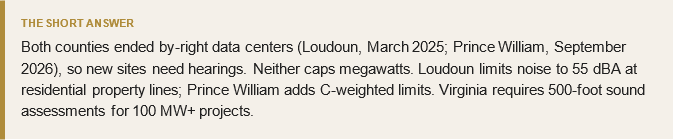
Northern Virginia’s “Data Center Alley” is the largest data center market in the world, and the two counties at its center have tightened the rules fast. For landowners, buyers near industrial corridors, and anyone weighing a sale to a developer, the key changes are where data centers are allowed, how loud they can be, how close they can sit to homes, and how they get power.
Loudoun County
Zoning: by-right approval is gone
On March 18, 2025, the Loudoun Board of Supervisors voted 7–2 to make data centers a special exception use in the districts where they had been allowed by right. Every new application now needs a Planning Commission hearing and a Board hearing. Applications filed before February 12, 2025 kept the old rules if the project is more than 500 feet from homes and is actively pursued; growing a project’s square footage by more than 5% ends that protection. The same day, the Board amended the Comprehensive Plan to make data centers a “conditional” use in several planned place types.
Noise
Loudoun’s limit is 55 dBA at the property line of residential property. Developers must submit a noise study at site plan review and another one 1 to 12 months after the first certificate of occupancy. Rules on tonal and low-frequency noise are expected in 2027.
Coming next: Phase 2 standards (drafts, not adopted)
Loudoun’s draft data center standards are scheduled for a Planning Commission hearing in February 2027 and a Board hearing in July 2027. The draft proposes setting substations back 500 feet from residential
(air-insulated) or 200 feet (gas-insulated), up from 100 feet today; requiring a 20-foot opaque screen around substations; setting on-site power plants at least 200 feet from residential with at least 2 acres per 100 MW of generation; and requiring a noise assessment for homes and schools within 500 feet.
Prince William County
Zoning: overlay shrunk, by-right ended
On September 22, 2026, Prince William supervisors unanimously voted to shrink the Data Center Opportunity Zone Overlay District from about 9,700 acres to about 3,641 (final boundaries pending) and end by-right approval for most new data centers, which will now need a special use permit. Owners have a 90-day window to qualify for the smaller overlay. Countywide performance standards, including setbacks from homes, have been signaled but not released.
Noise
Since February 2023, data center cooling equipment has been held to the county’s 55-decibel residential limit from 10 p.m. to 9 a.m., after the Board removed the nighttime exemption for commercial HVAC. In October 2025 the Board adopted a new noise ordinance that adds C-weighted limits, which capture the low-frequency hum neighbors complain about. It has no grandfathering for existing facilities.
The Digital Gateway is dead
The PW Digital Gateway rezonings were voided in August 2025 for improper public notice. The Court of Appeals upheld that ruling on March 31, 2026, the county chose not to appeal, and QTS withdrew its appeal in July 2026, ending the project.
Statewide rules that apply in both counties
Site assessments (Code of Virginia § 15.2-2209.4, in effect July 1, 2026): for any facility expected to need 100 MW or more, the locality must require a site assessment before a rezoning, special exception, or special use permit. It must include a sound profile for homes and schools within 500 feet, and the utility must describe the substations and transmission voltage needed.
Generators: starting July 1, 2026, Virginia DEQ requires Tier 4-equivalent emissions for new or modified backup generators.
Power delivery: Dominion Energy’s new GS-5 rate class, approved by the State Corporation Commission in November 2025, takes effect in January 2027 for customers drawing more than 25 MW. It uses 14-year contracts with minimum payments of 85% of contracted transmission and distribution demand and 60% of generation demand. In practice, the grid connection queue — reported at more than 40 GW in Dominion’s territory — is the real limit on new capacity.
Tax incentives: Virginia’s sales and use tax exemption on data center equipment remains in place for operators investing $150 million and creating 50 jobs at 1.5 times the local average wage ($70 million and 10 jobs in distressed localities). It runs through July 1, 2035. The 2026 state budget also added a charge of $0.011 per kWh on data center electricity from July 1, 2026 through June 30, 2028.
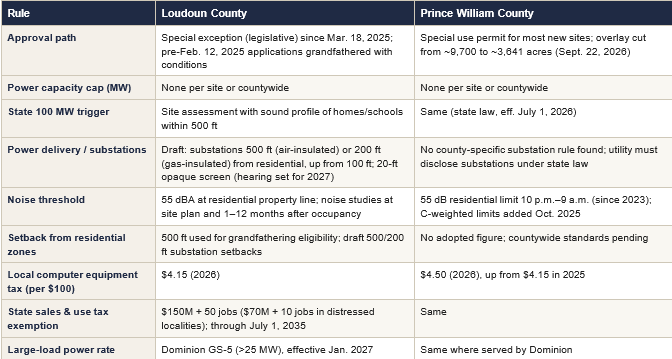
Comparison table: Data Center Alley at a glance
Frequently asked questions
Can you still build a data center by right in Loudoun or Prince William County?
Generally no. Loudoun made data centers a special exception use in March 2025, and Prince William ended by-right approval for most new sites in September 2026, so both require a public hearing and a Board vote, aside from grandfathered projects.
Is there a megawatt cap on data centers in Northern Virginia?
No. Neither county nor the state caps capacity per site or countywide. The 100 MW mark triggers Virginia’s site assessment requirement, and 25 MW triggers Dominion’s GS-5 rate class. Grid connection capacity is the practical limit.
What noise limits apply to data centers?
Loudoun limits noise to 55 dBA at residential property lines and requires noise studies before and after opening. Prince William holds data centers to its 55-decibel nighttime residential limit and added C-weighted limits for low-frequency noise in 2025.
How far must data centers be from homes?
Neither county has a final adopted standard. Loudoun’s draft would set substations 500 feet (air-insulated) or 200 feet (gas-insulated) from residential. State law requires a sound profile for homes and schools within 500 feet for projects of 100 MW or more.
What tax incentives do data centers get in Virginia?
A state sales and use tax exemption on equipment for operators investing $150 million and creating 50 qualifying jobs, through July 1, 2035. Locally, computer equipment is taxed at $4.15 per $100 in Loudoun and
$4.50 in Prince William for 2026.
This article is general information, not legal advice. Data center rules in both counties are changing quickly; confirm current requirements with the county planning office and a land use attorney.
Best Transit-Accessible Neighborhoods for a Metro Commute to Downtown D.C.: Northern Virginia vs.
Montgomery County
By Reginald “Reggie” Butler Jr., Broker/Owner, CENTURY 21 ENVISION | Updated October 2026 | 7-minute read
Both sides of the river have neighborhoods where you can walk to Metro and be downtown in under 25 minutes, plus big park-and-ride garages at the ends of the lines. Here are the station-by-station numbers.
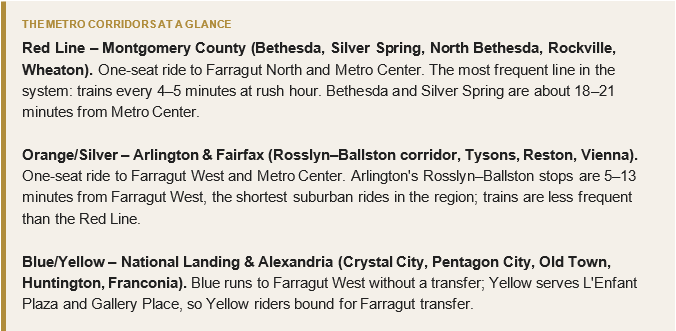
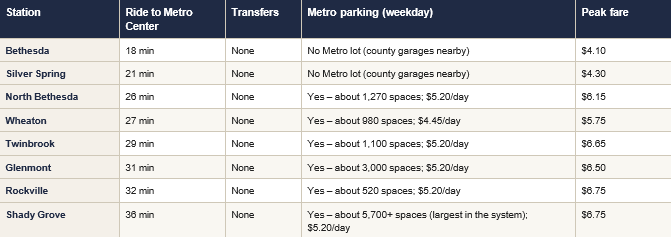
Montgomery County: the Red Line corridor
Every Red Line station in Montgomery County is a one-seat ride to Farragut North and Metro Center. Ride times are to Metro Center.
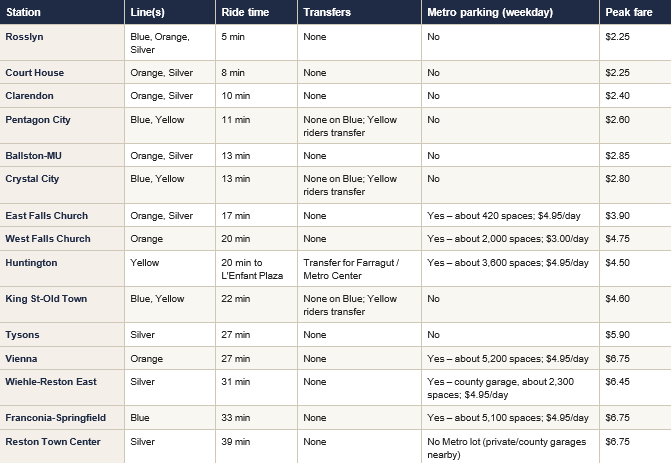
Northern Virginia: Orange, Silver, Blue and Yellow
Orange, Silver and Blue trains stop at both Farragut West and Metro Center. Ride times are to Farragut West unless noted.
Ride times are WMATA’s published station-to-station times and do not include waiting, walking, or transfer time. Parking fees are WMATA’s rider rates under the tariff effective July 1, 2026; some stations charge non-riders more (up to $8.95). Space counts are approximate and based on WMATA’s most recent published counts. Metro parking is free for riders on weekends and federal holidays.
Head-to-head: Wiehle-Reston East vs. Shady Grove
These are the two classic end-of-line park-and-ride commutes. Shady Grove has the most Metro parking in the system (5,700+ spaces), a 36-minute ride to Metro Center with no transfer, and Red Line trains every 4–5 minutes at rush hour, so you rarely wait long. Wiehle-Reston East has a roughly 2,300-space Fairfax County garage, a 31-minute ride to Farragut West with no transfer, and a slightly cheaper $4.95 daily rate, but Silver Line trains come less often. Peak fares are $6.75 from Shady Grove and $6.45 from Wiehle-Reston East.
Which neighborhood fits which commuter?
1. Rosslyn–Ballston corridor (Arlington)
Shortest suburban commute in the region (5–13 minutes to Farragut West), walkable, condo- and apartment-heavy. Best for: car-free commuters who want the fastest ride.
1. Bethesda (Montgomery County)
18 minutes to Metro Center on the Red Line, with frequent trains and a busy downtown. Best for: walkable suburban living with top-tier schools.
2. Silver Spring (Montgomery County)
21 minutes to Metro Center, plus the Purple Line light rail now under construction. Best for: value and urban amenities on the Red Line.
3. National Landing – Crystal City & Pentagon City (Arlington)
11–13 minutes to Farragut West on the Blue Line, next to Amazon HQ2 and Reagan National Airport. Best for: travelers and tech workers.
4. North Bethesda / Pike District (Montgomery County)
26 minutes to Metro Center, with newer mixed-use development around the station. Best for: newer construction near the Red Line.
5. Old Town Alexandria
22 minutes to Farragut West from King St-Old Town on the Blue Line. Best for: historic charm with a manageable commute.
6. Tysons and Reston (Fairfax County)
27–39 minutes on the Silver Line, with newer high-rise and town-center living. Best for: people who split time between a D.C. office and the Dulles tech corridor.
7. Park-and-ride hubs: Shady Grove, Glenmont, Vienna, Franconia-Springfield
Large garages at the ends of the lines. Best for: single-family-home buyers farther out who drive to Metro.
Know before you commute
Fares: Metrorail currently costs $2.25 to $6.75 per peak trip, with a $2.50 maximum late nights and weekends. WMATA’s FY2027 budget kept fares flat, but an increase of about 11% (to $2.50–$7.50) has been floated for July 1, 2027 and has not been approved. WMATA has also floated replacing station-by-station parking rates with $3/$5/$7 tiers.
Frequency: Red Line trains run every 4 minutes at the busiest part of rush hour and every 5 minutes the rest of the peak. Starting in December 2026, Orange, Silver and Blue trains run every 10 minutes on weekdays until 9:30 p.m.
Planned shutdowns: Blue, Orange and Silver close between Foggy Bottom and Pentagon/Court House the weekend of October 17–18, 2026. In July 2027, the Red Line is scheduled to close between Twinbrook and Shady Grove for an extended shutdown. Check wmata.com before you buy if your commute depends on one station.
Frequently asked questions
Which is faster to downtown D.C., Northern Virginia or Montgomery County?
Arlington’s Rosslyn–Ballston stations have the shortest rides (5–13 minutes to Farragut West). In Montgomery County, Bethesda and Silver Spring are the fastest at about 18–21 minutes to Metro Center. Farther out, Shady Grove (36 minutes) and Wiehle-Reston East (31 minutes) are similar.
Which Metro stations have the most parking?
Shady Grove has the most (5,700+ spaces), followed by Vienna, Franconia-Springfield, Huntington, Glenmont, and the Wiehle-Reston East county garage. Close-in stations like Bethesda, Silver Spring, Rosslyn, Clarendon, and Crystal City have no Metro parking.
Do I need to transfer to get downtown?
Not from the Red, Orange, Silver, or Blue lines: all of them stop at Metro Center, and Red stops at Farragut North while Orange, Silver, and Blue stop at Farragut West. Yellow Line riders from Huntington transfer at L’Enfant Plaza or Gallery Place.
How much does Metro parking cost?
Under the tariff effective July 1, 2026, weekday rider parking at the stations in this guide ranges from $3.00 (West Falls Church) to $5.20 (Shady Grove, Rockville, Twinbrook, North Bethesda, Glenmont). It is free for riders on weekends and federal holidays.
Ride times, fares, and parking rates come from WMATA and can change. Confirm with WMATA’s trip planner before making a decision based on a specific commute.
Paste these JSON-LD blocks into the published blog page. Copy them from the accompanying metro-schema-markup.html file rather than from this PDF, since long lines below are wrapped for printing. The first ItemList describes every station as a Place with ride time, transfers, parking, and fare; the second marks up the neighborhood picks.
How Do I Register a Business and Pay Taxes If I Live in Montgomery County, MD, but Work in Washington, D.C. and Northern Virginia?
By Reginald “Reggie” Butler Jr., Broker/Owner, CENTURY 21 ENVISION | Updated October 2026 | 8-minute read
If you live in Montgomery County and your clients, listings, or job sites are spread across the DMV, you are dealing with three tax systems at once. The good news: Maryland, D.C., and Virginia have rules that keep most wage earners from being taxed twice. The catch: those rules are built for W-2 paychecks. If you are
self-employed, a 1099 independent contractor (like most real estate agents), or you own an LLC, you have more registrations to handle and more returns to file. Here is how it works, piece by piece.
How tax withholding reciprocity works across the DMV
Maryland–Virginia reciprocity (W-2 wages only)
Virginia and Maryland have a reciprocal agreement: a Maryland resident who earns only salary or wages in Virginia is exempt from Virginia income tax and pays Maryland instead. Give your Virginia employer Form VA-4 to stop Virginia withholding. If Virginia tax was withheld anyway, file Form 763-S to get it back.
The limit: reciprocity covers wages and salaries only. Business, 1099, rental, or other Virginia-source income is taxable in Virginia. You file a Virginia nonresident return (Form 763) and then claim a credit for the Virginia tax on your Maryland return using Form 502CR, so you are not taxed twice.
D.C. nonresident rules
D.C. does not tax the personal income of nonresidents. As a Maryland resident who works in D.C., give your employer Form D-4A (Certificate of Nonresidence) so no D.C. tax is withheld from your paycheck.
The catch for business owners: D.C. charges an unincorporated business franchise tax (UBT) on sole proprietorships, partnerships, and LLCs that have more than $12,000 of D.C. gross income. Virginia’s own guidance points out that reciprocity does not cover this tax. The UBT rate is 8.25%, with a $250 minimum tax when D.C. gross receipts are $1 million or less. The business is exempt if more than 80% of its gross income comes from personal services performed by its owners and capital is not a material income-producing factor. Many solo service providers and agents may qualify for that exemption. Confirm with your tax preparer.
Maryland: where your income tax lands
As a Maryland resident, you report all of your income on Maryland Form 502, wherever you earned it. You also pay the Montgomery County local income tax, which is 3.20% for 2026. Montgomery County moves to a graduated local rate (2.70%, 3.00%, and 3.30% brackets) for 2027.
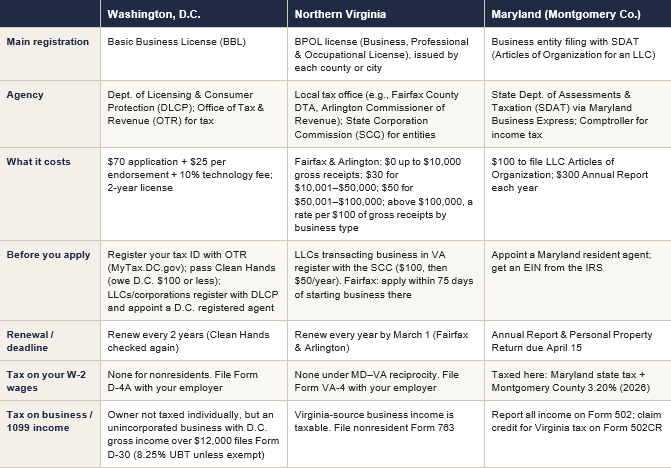
Comparison: D.C. BBL vs. Virginia BPOL vs. Maryland SDAT
BPOL thresholds and rates vary by locality. Alexandria, Fairfax City, Falls Church, and towns such as Herndon and Vienna run their own license programs, so check with the locality where you work. Contractors based elsewhere who do more than $25,000 of work in Fairfax County in a license year need a Fairfax County BPOL license.
Step by step: how to register and stay compliant in all three
Step 1: Set up your business in Maryland
Choose your structure. For an LLC, file Articles of Organization with SDAT through Maryland Business Express ($100) and appoint a Maryland resident agent. Get a free EIN from the IRS.
Step 2: Register for Maryland taxes if needed
If you will have employees or collect sales tax, register with the Comptroller of Maryland. Plan to file the $300 SDAT Annual Report every April 15.
Step 3: Get licensed in D.C.
If you have an LLC or corporation, register it with DLCP’s Corporations Division and appoint a D.C. registered agent. Register your tax ID with OTR on MyTax.DC.gov, make sure you owe D.C. no more than $100 (Clean Hands), then apply for your Basic Business License.
Step 4: Get licensed in Northern Virginia
If your LLC transacts business in Virginia, register it with the SCC ($100). Then apply for a BPOL license with each county or city where you do business. In Fairfax County, apply within 75 days of starting work there.
Step 5: Fix your withholding paperwork
If you earn W-2 wages, give D.C. employers Form D-4A and Virginia employers Form VA-4 so only Maryland tax is withheld.
Step 6: File the right returns
File Maryland Form 502 (state + county tax) on all income. If you have Virginia business income, file Virginia Form 763 and claim the credit on Maryland Form 502CR. If your unincorporated business has more than
$12,000 of D.C. gross income, file D.C. Form D-30. Make quarterly estimated payments if you are self-employed.
Step 7: Put renewals on your calendar
March 1: Virginia BPOL renewals (Fairfax & Arlington). April 15: Maryland SDAT Annual Report. Every 2 years:
D.C. BBL renewal. Each anniversary month: Virginia SCC $50 annual fee for registered LLCs.
Frequently asked questions
Do I pay D.C. income tax if I live in Maryland and work in D.C.?
No. D.C. does not tax nonresidents’ personal income. Give your employer Form D-4A. If you run an unincorporated business with more than $12,000 of D.C. gross income, though, the business may owe D.C.’s 8.25% unincorporated business franchise tax unless it qualifies for the personal-services exemption.
Does the Maryland–Virginia reciprocity agreement cover 1099 or self-employment income? No. It covers wages and salaries only. Self-employment and other business income earned in Virginia is taxed by Virginia on Form 763, and Maryland gives you a credit for that tax on Form 502CR.
What is Virginia’s BPOL tax, and do I need it if my office is in Maryland?
BPOL is a local license tax on gross receipts charged by Virginia counties and cities. Whether you owe it depends on the locality and your activity there. For example, Fairfax County requires contractors based elsewhere to get a license once they do more than $25,000 of work in the county in a year. Check with each locality where you work.
Do I need a D.C. Basic Business License?
Almost every business operating in D.C. needs one. You must register your tax ID with D.C.’s Office of Tax and Revenue and pass a Clean Hands check (owing D.C. $100 or less) before DLCP will issue it. Licensed professionals, like real estate agents, still need their separate professional license.
What does a Maryland LLC owe SDAT every year?
Most Maryland LLCs file an Annual Report and Personal Property Return by April 15, with a $300 filing fee.
What is the Montgomery County local income tax rate?
3.20% for tax year 2026. Montgomery County moves to graduated local rates of 2.70%, 3.00%, and 3.30% for 2027.
The bottom line
Living in Montgomery County and working across the DMV is very doable — it just takes setting things up right the first time. Register in Maryland, license in each place you do business, get your withholding forms in place, and calendar your renewals. Then put your energy where it belongs: serving clients and growing your business.
This article is general information, not tax or legal advice. Rules, rates, and fees change, and your situation may differ. Confirm the details with a CPA or tax attorney licensed in Maryland, D.C., and Virginia before you file.
Paste these JSON-LD blocks into the <head> or body of the published blog page. Copy them from the accompanying
schema-markup.html file rather than from this PDF, since lines below are wrapped for printing. Google no longer shows HowTo rich results and limits FAQ rich results to authoritative government and health sites, but this markup still gives search engines and AI answer engines a clean, structured version of the Q&A and steps.
Short answer: for many Bowie homeowners, fall 2026 is a favorable time to sell — but not for the reason most people assume.
It is not because prices are climbing fast. They aren’t. It’s because Prince George’s County has roughly 16% fewer homes on the market than it did a year ago, which means your listing faces unusually little competition
— while mortgage rates have reached 7.03% and the Federal Reserve is currently raising rates rather than cutting them. If that continues, the pool of buyers who can afford your house gets smaller over time.
Nobody can tell you where rates go from here, including the Fed. But if you already know you need to sell within the next 12 to 24 months, the conditions in front of you today are better than the ones most forecasters are projecting. If you’re selling only to buy another home in the same market, the answer is more complicated, and I walk through that below.
Last updated: September 28, 2026.
A disclosure before I go further: I’m a listing broker, and I get paid when homes sell. Read what follows knowing that, and check the underlying data yourself — I’ve sourced all of it at the bottom.
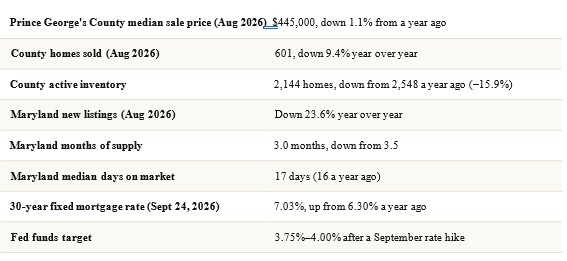
Quick facts: the Bowie and Prince George’s County market right now
Bowie generally runs at the higher end of the county on price, given the housing stock, school assignments and commute position between D.C., Annapolis and Baltimore. As a rough reference point, Zillow’s home-value
index for Bowie was about $527,000 as of spring 2026. Note that a home-value index and a median sale price measure different things and aren’t directly comparable.
Why is now a good time to sell a house in Bowie?
Three things are true at once, and together they favor sellers.
Inventory is scarce, and getting scarcer. Maryland sellers brought 23.6% fewer new listings to market in August 2026 than in August 2025. Prince George’s County active inventory fell nearly 16%. Statewide supply is down to three months — well under the five to six months that signals a balanced market. Fewer competing listings means fewer price reductions, fewer bidding wars against you, and more buyer attention on your house.
This is the part that surprises people, because the national story is the opposite. Inventory nationally is rising, and across the broader Washington D.C. metro, active listings were up 11.3% in August. Maryland is moving against that current. If you live in Bowie, the national headlines are describing a market you’re not actually in.
Homes that are priced right still move fast. Maryland’s median time on market in August was 17 days — one day slower than a year ago, but still well short of the 60- and 90-day markets people picture when they hear
“cooling.” A correctly priced, well-prepared Bowie home does not sit.
The affordability window is closing, not opening. This is the one most sellers get wrong.
Should I wait for mortgage rates to come down before selling?
That’s a bet, and right now it’s a bet against the direction the Federal Reserve is moving.
On September 16, 2026, the Fed raised its benchmark rate by a quarter point to a 3.75%–4.00% target range.
That was its first increase in more than three years, and the vote was unanimous, 12–0. Sixteen of eighteen
committee participants projected at least one more hike. Core PCE inflation has run near or above 3% all year and was roughly 3.6% in August.
Mortgage rates followed. Freddie Mac’s 30-year fixed averaged 7.03% on September 24, 2026, up from 6.30% at the same point in 2025. Anyone who waited a year for cheaper money got 73 basis points of the opposite.
The forecasts don’t promise relief either. As of its September 2026 outlook, the Mortgage Bankers Association projects 30-year rates near 6.8% through mid-2027. Fannie Mae has it around 6.8% near-term, easing to about 6.7% across the balance of 2027. No major forecaster currently expects a return below 6%.
None of that is a guarantee — forecasts get revised constantly, and a few Fed participants do see cuts in 2027. But “wait for rates to drop” is a hope rather than a plan, and over the past twelve months it has cost people money.
WHAT HIGHER RATES DO TO YOUR BUYER POOL
Here’s the arithmetic that matters to you as a seller. Take a buyer with a fixed monthly budget of roughly
$2,980 in principal and interest, putting 20% down:
At 30% (September 2025): that payment supported a purchase price near $602,000
At 03% (September 2026): the same payment supports about $559,000
Same buyer. Same budget. About $43,000 less house. Every tick upward in rates prices another slice of buyers out of your listing — and over the past year, rates have been ticking up.
Illustrative only. Principal and interest at 20% down; excludes taxes, insurance, HOA and PMI.
What is my Bowie home worth in 2026?
Prince George’s County’s median sale price in August 2026 was $445,000, down 1.1% from $450,000 a year earlier. Zillow’s separate home-value index for Bowie was near $527,000 as of spring 2026, essentially flat year over year (−0.2%). Those two numbers measure different things, but together they describe the same condition: values that are holding, not surging and not collapsing.
But county medians and automated valuations don’t price your house. In Bowie, a Belair-era rambler, a Fairwood colonial and a Saddlebrook townhome are three different markets on three different timelines. Street, school assignment, lot, condition, layout and what sold within a half-mile in the last 90 days matter far more
than any county number.
If you want the real figure, you need a comparative market analysis on your specific address.
Is 2026 a seller’s market or a buyer’s market in Bowie?
Prince George’s County is a mild seller’s market — but a quiet one.
Three months of supply is a seller’s market by the textbook. What’s missing is urgency. Buyer demand has
genuinely softened: sales are down 9.4% year over year in the county, new pending contracts across the D.C. metro fell 11.5% in August, and showing activity dropped 7.3%.
So this is not 2021. You will not get fifteen offers in a weekend on an overpriced house. What you will get, if you prepare and price correctly, is a market with very few alternatives for the buyers who are out looking — and those buyers are motivated, because the ones still shopping at 7% are the ones who have to move.
When is the worst time to sell a house in Bowie?
Being honest about the other side, here’s when I tell homeowners to wait:
You’re selling to buy in the same market and you hold a low rate. If you’re sitting on a 3% mortgage,
trading it for 7% on a comparable house raises your payment substantially even at the same price point — on a
loan in the $350,000 to $450,000 range, that’s roughly $850 to $1,100 more per month in principal and interest. That’s the single strongest reason to stay put. Sometimes the right answer is a renovation, not a sale.
Your home needs work you can’t fund. In a market with fewer buyers, condition gaps get punished. Buyers tend to discount visible deferred maintenance by more than it would cost you to fix, because they’re pricing in hassle and unknowns on top of the repair. Fix it first or price it honestly — don’t do neither.
You’d close underwater or barely above. If you bought recently with a low down payment, run your net sheet before anything else. Between commission, transfer and recordation taxes and closing costs, you need real
equity to sell without bringing money to the table.
You’re moving again inside two years. Transaction costs on both ends rarely pencil out over a short hold.
What’s the best month to list a house in Bowie?
Spring — roughly March through May — is the heaviest buyer-traffic stretch in most Mid-Atlantic markets, and if your timing is fully flexible, that’s the conventional window.
But the spring advantage is smaller than the inventory advantage you have right now. Every seller who waits for spring becomes your competition in spring. Listing into a market with 16% less inventory and 23.6% fewer new listings is a structural edge that disappears the moment everyone else lists. Weigh scarcity now against traffic later.
One caution specific to fall 2026: if the Fed hikes again, spring buyers will be qualified for less than today’s buyers are.
How do I sell my Bowie house for the most money in this market?
In a market where buyers are scarce and rate-sensitive, execution is the whole game.
Price it right the first week. Your listing gets the largest audience it will ever have in its first ten days, when it surfaces as new inventory in every buyer’s saved search. An overpriced house burns that window and then
chases the market downward. In a 17-day-median market, a stale listing reads as a problem.
Have your documentation ready for the appraisal. With values flat to slightly down county-wide, appraisal gaps are a common place for deals to fall apart. Assemble your permit records and improvement receipts so the appraiser has complete information about the property. The appraiser reaches an independent conclusion — the point is to make sure nothing about your house is invisible to them.
Pre-inspect. Buyers financing at today’s rates have less cash cushion for surprises. Knowing your issues up front lets you control the negotiation instead of reacting to it. A pre-inspection doesn’t replace Maryland’s required property disclosure or disclaimer, and what you learn may become disclosable — worth discussing before you order one.
Consider a rate buydown as an alternative to a price cut. A seller-paid temporary buydown targets the
buyer’s monthly payment directly — which, at these rates, is the number they’re actually shopping. Whether it costs you more or less than an equivalent price reduction depends on the loan size and structure, and lender and loan-program rules limit what’s allowed, so run both options side by side with a lender before you choose.
Market to the buyer who’s actually out there. Fewer buyers means each one matters more. Professional photography, a real marketing plan and broad syndication aren’t extras in this market.
Frequently asked questions
Is 2026 a good year to sell a house in Bowie, Maryland?
Conditions favor sellers. Prince George’s County inventory is down about 16% year over year and Maryland
new listings are down 23.6%, so sellers face unusually little competition. Meanwhile mortgage rates have risen to 7.03% and the Fed raised rates in September 2026, which tends to shrink the buyer pool over time.
Are home prices going down in Bowie, Maryland?
Slightly. Prince George’s County’s median sale price was $445,000 in August 2026, down 1.1% from a year earlier. Zillow’s Bowie home-value index was down about 0.2% year over year. This is flat-to-soft, not a crash.
How long does it take to sell a house in Bowie?
Maryland’s median time on market was 17 days in August 2026 — one day slower than a year ago — and the
D.C. metro median was 19 days. Correctly priced homes move quickly; overpriced ones sit much longer.
Will mortgage rates go down in 2027?
No major forecaster currently expects a drop below 6%. As of September 2026, the Mortgage Bankers
Association projects roughly 6.8% through mid-2027 and Fannie Mae projects about 6.8% near-term easing to 6.7%. The Fed raised rates in September 2026, and most committee participants projected at least one more
increase.
Should I sell my Bowie house now or wait until spring 2027?
Spring brings more buyers, but it also brings more competing sellers — and today’s inventory shortage is a real advantage that a spring listing wave would erase. If rates rise further, spring buyers will also qualify for less.
That trade-off favors listing sooner for many sellers, though it depends on your own timeline and equity position.
How much does it cost to sell a house in Maryland?
Expect brokerage commission, state and county transfer and recordation taxes, title and settlement fees, and any negotiated buyer closing-cost help. Ask for a written seller net sheet before you list so you know your walk-away number.
SOURCES
Maryland Association of REALTORS, August 2026 housing statistics (via The Washington Informer, 14, 2026)
Bright MLS August 2026 Housing Market Report, released 10, 2026
Freddie Mac Primary Mortgage Market Survey, 24, 2026
Federal Reserve FOMC decision, 16, 2026
Fannie Mae and Mortgage Bankers Association rate forecasts, 2026–2027
Zillow Home Value Index, Bowie, MD
This article is for general information and is not financial, tax or legal advice. Days-on-market figures cited here are Bright MLS medians; averages published by consumer real estate portals use different definitions and run considerably higher, and the two are not comparable. Payment and qualifying illustrations are 30-year fixed principal and interest only. Market data changes; figures reflect the most recent available as of September 28, 2026.
Short answer: budget 45 to 60 days from listing to closing. Montgomery County homes that sold in August 2026 were on the market a median of 15 days before going under contract, and a financed settlement typically adds another 30 to 45 days.
But there’s a second number you need, and almost nobody publishes it next to the first one. That 15-day figure only counts homes that sold. The listings sitting on the market in Montgomery County right now have a median age of about 43 days. Half of the active inventory has been available for longer than six weeks.
Both numbers are true. The gap between them is the whole story, and it’s the difference between a sale that wraps up in about seven weeks and one that drags on for months.
Last updated: September 28, 2026.
A disclosure before I go further: I’m a listing broker, and I get paid when homes sell. Read what follows knowing that, and check the underlying data yourself — I’ve sourced all of it at the bottom.
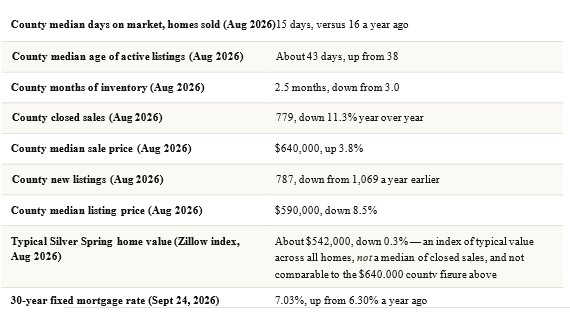
Quick facts: Silver Spring and Montgomery County timelines right now
Two notes on that table.
First, inventory. Realtor.com’s active listing count for Montgomery County is up 21.7% year over year, to 2,073. Bright MLS, via Maryland REALTORS, reports active inventory down over the same period, from 2,375 to 2,032. Those are the same nominal metric moving in opposite directions, and the gap comes from what each source counts — the two feeds treat coming-soon, pending and temporarily-off-market listings differently. I don’t think either is wrong; I do think it means nobody should hang a pricing decision on a single inventory
number. What both agree on: the listings that are sitting are sitting longer.
Second, you will see much higher day counts on Redfin and Realtor.com than the 15-day figure above. Those are averages, use different definitions, and are not the same measure as the Bright MLS median. Averages on days-on-market run far higher because a handful of very long-sitting listings pull them up.
Third, on the 15-day figure itself: that’s the Bright MLS median for closed county sales, and it is roughly flat
year over year. Some local brokerage commentary this August described homes as taking longer, which is what you’d expect if you were reading the active-inventory age rather than the closed-sale median, or a subset of the county. If the difference matters to your decision, ask me to pull the current Bright MLS report for your specific submarket rather than relying on any single county-wide number.
Silver Spring is also not a city. It’s an unincorporated part of Montgomery County, so there is no Silver Spring line in the official monthly statistics. Every county figure above includes Bethesda and Potomac, which run considerably higher.
How long does it take to sell a home in Silver Spring right now?
Break it into three stages, because “how long does it take” means different things to a seller getting ready to list, a seller under contract, and a seller trying to plan a move.
Prep, typically one to three weeks. Photography, repairs, decluttering, paint, and getting the house genuinely ready. This is the stage sellers skip and then pay for later in extra market days.
Market time, a median of 15 days for homes that sold. That’s the Montgomery County Bright MLS figure for August 2026. In practice it clusters. Well-prepared homes at defensible prices can go under contract in the first weekend, anywhere in Silver Spring. Homes that are dated, awkwardly laid out, or priced on hope can sit for months — also anywhere in Silver Spring. The variable is the house and the price, not the neighborhood.
Settlement, 30 to 45 days for a financed buyer. Appraisal, underwriting, title work, and the walkthrough. A cash buyer can close in as little as a week or two; a conventional loan with an appraisal issue or a repair
negotiation can stretch past 45 days.
Add those up and a realistic plan is 45 to 60 days from the day you list, and roughly two months from the day you decide to sell. If your house needs work first, extend the front end accordingly.
Why do the 15-day and 43-day numbers both exist?
This is the single most useful thing to understand about market timing, in Silver Spring or anywhere.
Median days on market is measured on closed sales. It’s a survivor statistic. It answers “of the homes that found a buyer, how fast did that happen?” By construction, it excludes every listing that is still sitting there unsold — which is exactly the population you most want to avoid joining.
The median age of active inventory is the opposite view. It answers “of what’s for sale right now, how long has it been for sale?” In Montgomery County that number is about 43 days and rising.
Read together: this is not a slow market. It’s a bifurcated one. There is a fast lane and a stalled lane, and which lane your listing lands in is decided largely in the first ten days by three things — price, condition, and
photography. Those first ten days are when your listing gets the largest audience it will ever have, because that’s when it surfaces as new inventory in every buyer’s saved search. In my experience, a house that misses that window tends to take both longer and less, because buyers read a listing that’s been sitting as a listing with a problem.
How long does settlement take after I go under contract?
Assume 30 to 45 days for a financed buyer. The sequence, roughly:
The inspection happens in the first week to ten days, and any repair negotiation follows. The lender orders the appraisal, which in Montgomery County usually comes back within two to three weeks of contract. Title work runs in parallel — the settlement company pulls the deed history, checks for liens, and resolves anything
outstanding. Underwriting clears in the final two weeks, and a walkthrough happens in the last day or two.
Things that reliably extend it: a low appraisal that requires renegotiation, a title problem such as an old lien or an estate issue, a buyer changing loan products mid-stream, and condo or co-op document delivery. Things that shorten it: cash, a pre-inspected house, and a settlement company that’s already pulled title before ratification.
What slows a Silver Spring sale down?
Some of the most common delays here are specific to the housing stock and to Montgomery County’s rules.
The age of the housing. A large share of Silver Spring’s housing stock dates to the 1940s through the 1960s, though this varies sharply by area — the inner neighborhoods near downtown skew much older than the postwar and later subdivisions farther out toward Aspen Hill and Olney. Where the house is mid-century, that era brings recurring items that turn into lender conditions or repair requests: buried heating oil tanks,
galvanized supply lines, 60- or 100-amp electrical service, asbestos in siding or floor tile, lead paint in pre-1978 homes, and basement moisture. None of these is fatal. All of them are faster and cheaper to address before you list than after an inspection report puts them in a buyer’s hands.
Tenants, if the house is a rental. Two different rules can apply, and they sit at different points in your timeline.
For smaller rentals, Maryland’s right-of-first-refusal statute requires the owner to give the tenant written notice
before offering the property for sale, after which the tenant has a window — 30 days under the statute — to deliver a written offer to purchase. That step happens before you list.
For larger buildings, Montgomery County’s right-of-first-refusal law works the other way around: you list and market normally, and once you have a ratified contract the County requires that the same terms be offered to Montgomery County, the Housing Opportunities Commission, and any certified tenant organization, on a short deadline after ratification. Those windows — commonly 60 days for the County or HOC and up to 90 for a certified tenant organization — sit between ratification and closing, not before listing, so they extend your settlement rather than your market time.
Unit-count thresholds, notice forms and deadlines are technical, and the state and county rules can overlap at the margin. If you own a Silver Spring rental of any size, have a Maryland attorney map the sequence for your specific property before you do anything — a missed statutory deadline can unwind a sale.
Deferred maintenance you decided to let the buyer handle. In a market where buyers are financing at 7%, they have no cash cushion for surprises, and they discount unknown conditions more heavily than the repair would have cost you.
Pricing above the comps. The 43-day active-inventory median is made almost entirely of this.
What makes a Silver Spring home sell faster?
Price set from closed comps within a half-mile, not from what your neighbor is asking. Listed prices are opinions; closed prices are what appraisers and buyers actually work from.
Condition and presentation done before the first photo. Paint, floors, decluttering, landscaping, lighting, and a deep clean. These are the highest-return dollars in a bifurcated market because they decide which lane you land in.
Professional photography and a real marketing plan. Nearly every buyer sees your house on a screen before they see it in person, and in Silver Spring’s older housing stock, photography is doing a lot of work.
A pre-inspection. Knowing your own issues lets you fix, disclose, or price them on your terms instead of reacting to a buyer’s report on day nine. A pre-inspection is not a substitute for Maryland’s required property disclosure or disclaimer, and anything you learn from it may become disclosable — another reason to talk it through before you order one.
Proximity and transit access, which you can’t change but should market. The Red Line stops at Silver Spring, Forest Glen, Wheaton and Glenmont; the FDA’s White Oak campus is a major nearby employer; and the Purple Line is under construction with officials targeting late 2027, though that date has already moved and nobody can promise what any given line does to a specific house’s value.
Does the time of year change how fast my Silver Spring home sells?
Spring, roughly March through May, is the heaviest buyer-traffic window in most Mid-Atlantic markets, and market times are generally shortest then.
The countervailing point for fall 2026 is supply. Montgomery County new listings in August were 787 against 1,069 a year earlier — a drop of about 26%. Fewer competing sellers right now is a real advantage, and every seller who waits for spring becomes part of the spring wave. Whether the extra traffic later outweighs the lower competition now depends on your own timeline, your equity, and how ready your house is today.
Frequently asked questions
How long does it take to sell a house in Silver Spring, Maryland?
Plan on 45 to 60 days from listing to closing. Montgomery County homes that sold in August 2026 spent a median of 15 days on the market, and a financed settlement typically adds 30 to 45 days. Homes that need work, or that are priced above the comps, can take considerably longer.
Why is the median days on market only 15 days when houses seem to sit for months?
Because median days on market counts only homes that sold. The listings currently active in Montgomery
County have a median age of about 43 days. The market is split between homes that go under contract quickly and homes that stall, and pricing and condition largely decide which group a listing joins.
How long does settlement take in Montgomery County?
Usually 30 to 45 days for a buyer using financing, covering inspection, appraisal, title work and underwriting.
A cash buyer can close in a week or two. Low appraisals, title issues and repair renegotiations are the most common causes of delay.
Is the Silver Spring market slowing down in 2026?
Sales volume is down — Montgomery County closed 779 sales in August 2026, an 11.3% drop — while the median sale price rose 3.8% to $640,000 and market time held roughly flat at 15 days. Active listing counts are up and asking prices have softened. It’s a slower, more price-sensitive market, not a collapsing one.
Do I have to notify my tenant before selling my Silver Spring rental?
Often yes, and the timing depends on the size of the property. For smaller rentals, Maryland’s right-of-first-refusal statute requires written notice to the tenant before the property is offered for sale, with a window for the tenant to deliver a written offer — a step that comes before you list. For larger buildings, Montgomery County requires that a ratified contract’s terms be offered to the County, the Housing Opportunities Commission, and any certified tenant organization shortly after ratification, so those windows fall between contract and closing.
Unit thresholds and deadlines are technical; have a Maryland attorney map the sequence for your property before you list.
What’s the fastest way to sell a house in Silver Spring?
A cash buyer is fastest, often one to two weeks, but typically at a discount to market. For most sellers the faster
and better-netting route is a correctly priced, pre-inspected, well-photographed listing, which in this market tends to go under contract inside the first two weeks.
SOURCES
Maryland REALTORS, August 2026 housing statistics (Bright MLS data), Montgomery County and statewide
com active-listing and median-listing-price data via FRED, Montgomery County, August 2026
Zillow Home Value Index, Silver Spring, MD, August 2026
Freddie Mac Primary Mortgage Market Survey, 24, 2026
Maryland Code, Real Property 8-119 (tenant right of first refusal)
Montgomery County Code 53A-4 and DHCA right-of-first-refusal guidance
S. Census Bureau, American Community Survey 2020–2024, housing age by year built
This article is for general information and is not legal, tax or financial advice. Timelines vary by property, buyer financing, and title condition. Market data changes; figures reflect the most recent available as of September 28, 2026. Confirm any tenant-notice or right-of-first-refusal requirement with a Maryland-licensed attorney.


 Facebook
 X
X
 Pinterest
 Copy Link

 Price ranges are based on Prince Frederick sales from July to September 2026.