

 Facebook
 X
 Pinterest
 Copy Link
What Permits and Historic Approvals Do You Need to Add Solar Panels or Renovate a Home in Old Town Alexandria vs. Georgetown?
By Reginald “Reggie” Butler Jr., Broker/Owner, CENTURY 21 ENVISION | Updated October 2026 | 7-minute read
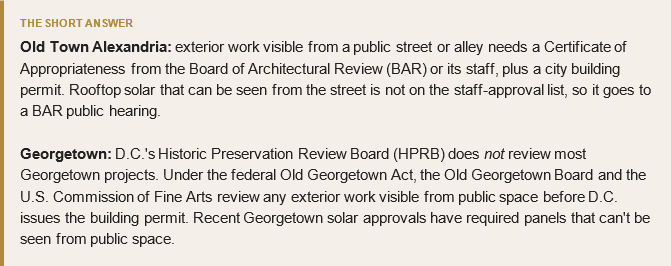
Old Town Alexandria and Georgetown are two of the most protected historic neighborhoods in the country. Buying there means a beautiful house, but also an extra layer of review before you change anything the public can see. The rule of thumb in both places: if it’s visible from the street, plan for historic review and a building permit. If it isn’t, the process gets much simpler.
Old Town Alexandria: the Board of Architectural Review (BAR)
The BAR is a seven-member board appointed by Alexandria City Council. It reviews exterior changes in the Old and Historic Alexandria District (created in 1946), the Parker-Gray District, and individually designated
100-year-old buildings.
Two kinds of approval
Certificate of Appropriateness (COA): needed for new construction and exterior alterations visible from a public street, alley, or other public way. Permit to Demolish/Capsulate: needed to demolish or cover more than 25 square feet of existing material — even if no one can see it. If a project needs both, they’re filed as two separate applications in the city’s APEX permit portal.
Three levels of review
Some work needs no BAR approval at all (work not visible from the public way, storm windows, plantings, routine maintenance). A long list of common items can be approved by BAR staff, usually in under five business days — for example rear or side fences up to 6 feet, minimally visible HVAC units, EV chargers, in-kind roof replacement, small skylights on non-street sides, and sheds up to 65 square feet. About three of every four applications are approved by staff. Everything else goes to a public hearing.
Solar panels in Old Town
Virginia law lets homeowners install rooftop solar by right, but still subject to local historic-district rules. In Alexandria, solar that is visible from the public right-of-way needs BAR approval at a hearing; it is not on the staff-approval list. The BAR’s solar guidelines (updated July 2025) call for panels that are minimally visible and low-profile, mounted close to the roof slope, placed on secondary or accessory structures where feasible, and within zoning height and setback limits. Panels that can’t be seen from the public way don’t need BAR review — confirm that with Preservation staff first.
Timing and fees
The BAR meets the first and third Wednesday of each month (no August meetings). A complete application is due about five weeks before the hearing. Current residential fees include $110 for a staff approval and $135 for alterations that add no floor area. BAR approval does not replace your building permit from Code Administration, which is also filed through APEX.
Georgetown: the Old Georgetown Board and Commission of Fine Arts
Georgetown is the exception to how historic review works everywhere else in D.C. The Old Georgetown Act of 1950 requires D.C. to send permit plans for building, altering, or demolishing anything visible from a public street to the U.S. Commission of Fine Arts (CFA), a federal agency. The CFA’s three-member Old Georgetown Board (OGB) does the detailed review. A separate HPRB application isn’t needed.
What needs review
Exterior changes visible from public space — including rear elevations, since staff check visibility in person and don’t count trees or shrubs as screening — plus demolition, new fences, storefronts, and signs. Minor repairs, repointing, storm windows, and underground utilities are exempt.
How the process works
You file your building permit application with D.C.’s Department of Buildings first, then email the OGB referral form and a combined PDF to D.C.’s Historic Preservation Office (HPO) at least three weeks before the OGB meeting. The OGB meets monthly, usually the first Thursday (no meetings in January or August). Routine projects go on a consent calendar and you don’t need to attend. Review is final when the full Commission of Fine Arts approves the OGB’s recommendations, about two weeks after the OGB meeting. HPO then clears the permit.
Solar panels in Georgetown
The OGB has no separate published solar policy. Recent approvals (for example, two rooftop solar permits in June 2025) were conditioned on the panels not being visible from public space, confirmed with mock-ups, with conduit kept to the rear. Plan for a low, hidden array on a flat or rear roof.
How HPRB works in the rest of D.C.
Outside Georgetown, D.C.’s historic districts (Capitol Hill, Dupont Circle, and others) are reviewed by HPO staff and the nine-member Historic Preservation Review Board, which meets monthly, usually the fourth Thursday. HPO staff approve minor work the same day or within about five business days; board cases take 30–60 days. D.C.’s solar guidance for those districts prefers secondary roof slopes and allows front slopes when needed if the panels are low-profile, flush with the roof, and set back from edges and ridges.
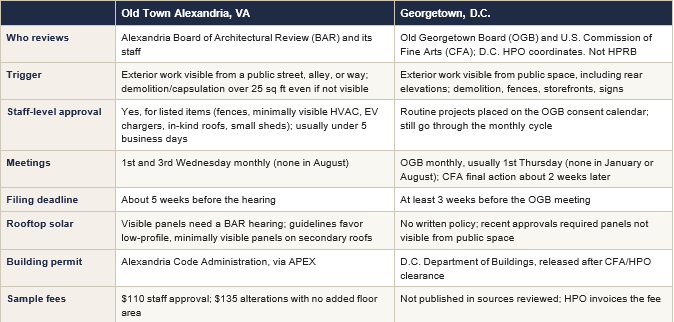
Side-by-side comparison
Step by step: how to check historic district maps in both jurisdictions
Step 1: Alexandria: open the Historic Preservation Map Viewer
Go to the City of Alexandria’s Historic Preservation Map Viewer (geo.alexandriava.gov, “historicpreservationviewer”). It shows the Old and Historic Alexandria District, the Parker-Gray District, and designated 100-year-old buildings.
Step 2: Alexandria: search the address and read the layers
Type the property address and check whether the parcel falls inside a local historic district boundary. Use the local district layers, not the National Register boundaries, which are different and don’t trigger BAR review.
Step 3: Alexandria: confirm with Preservation staff
Email preservation@alexandriava.gov or call 703-746-3833 to confirm the district and ask whether your project is staff-approvable. Ask about visibility before you design solar or an addition.
Step 4: D.C.: look up the address in PropertyQuest
Enter the address at propertyquest.dc.gov, the Office of Planning’s tool that shows historic district and landmark status for each lot.
Step 5: D.C.: check zoning on the D.C. Zoning Map
Open maps.dcoz.dc.gov and search the address to see the zoning district, which controls height, lot coverage, and setbacks for additions and solar mounting.
Step 6: D.C.: confirm whether Old Georgetown Act review applies
The Old Georgetown district runs roughly from Rock Creek Parkway (east) to Archbold Parkway (west), and from the Potomac River (south) to Dumbarton Oaks Park, Whitehaven Parkway, 35th Street and Reservoir Road (north). If you’re inside it, contact OGB staff at the Commission of Fine Arts (202-504-2200, georgetown@cfa.gov).
Frequently asked questions
Does the D.C. Historic Preservation Review Board review projects in Georgetown?
Generally no. Georgetown is governed by the Old Georgetown Act, so the Old Georgetown Board and the U.S. Commission of Fine Arts review visible exterior work. D.C.’s Historic Preservation Office coordinates the filing and permit clearance, and a separate HPRB application isn’t needed.
Can I put solar panels on a house in Old Town Alexandria?
Yes, but panels visible from a public street, alley, or way need BAR approval at a public hearing. The BAR’s guidelines favor low-profile panels mounted close to the roof on secondary or accessory roofs. Panels not visible from the public way don’t need BAR review. You also need a building permit.
Can I put solar panels on a house in Georgetown?
Often yes, if they’re hidden. The Old Georgetown Board has no written solar policy, but recent approvals were conditioned on panels not being visible from public space, confirmed with mock-ups.
How long does historic review take?
In Alexandria, staff approvals usually take under five business days; hearing cases follow the BAR’s
twice-monthly schedule with filing about five weeks ahead. In Georgetown, plan on at least one monthly OGB cycle plus about two weeks for Commission of Fine Arts action.
Do I still need a building permit after historic approval?
Yes, in both places. In Alexandria it comes from Code Administration through APEX. In D.C. it comes from the Department of Buildings, after historic clearance.
This article is general information, not legal advice. Rules, fees, and meeting schedules change; confirm with Alexandria Planning & Zoning, D.C.’s Historic Preservation Office, or the Commission of Fine Arts before starting a project.
Sources
Alexandria – Board of Architectural Review: https://www.alexandriava.gov/go/1382 Alexandria – Historic districts: https://alexandriava.gov/go/1714
Alexandria – BAR administrative approval policies (Sept. 2025): https://alexandriava.gov/sites/default/files/2025-09/admin_policies_updated_9.24.25.pdf
Alexandria – Design Guidelines: Solar Energy Systems (July 2025): https://www.alexandriava.gov/sites/default/files/2025-07/solar_energy_systems_pg.pdf
Alexandria – 2026 BAR hearing schedule:
https://www.alexandriava.gov/sites/default/files/2025-11/2026_bar_hearing_schedule_updated_11.7.25.pdf Alexandria – Fee Compendium: https://media.alexandriava.gov/content/budget/FeeCompendium.html Virginia Code § 15.2-2288.7 (residential solar): https://law.lis.virginia.gov/vacode/15.2-2288.7/
U.S. Commission of Fine Arts – Old Georgetown Act: https://www.cfa.gov/node/22093
U.S. Commission of Fine Arts – Old Georgetown Board FAQ: https://cfa.gov/node/8922
U.S. Commission of Fine Arts – How to submit: https://cfa.gov/node/40014
U.S. Commission of Fine Arts – Georgetown appendix, June 2025:
https://cfa.gov/records-research/record-cfa-actions/appendices/georgetown/46855
D.C. Office of Planning – Georgetown review: https://planning.dc.gov/node/1177760
D.C. DMPED – Historic preservation review process: https://dmped.dc.gov/sites/default/files/dc/sites/dmped/publication/attachments/DC% 20HP%20Review%20Process%20and%20Flow%20Chart.pdf
Greater Greater Washington – D.C. solar in historic districts:
D.C. PropertyQuest: https://propertyquest.dc.gov/


