

 Facebook
 X
 Pinterest
 Copy Link
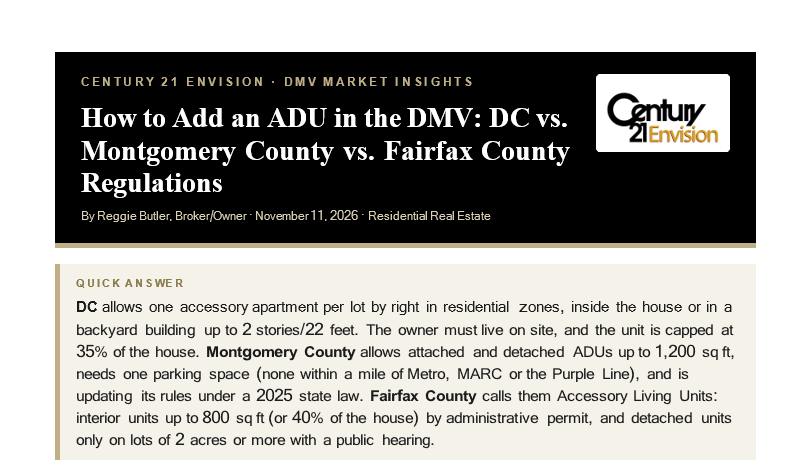
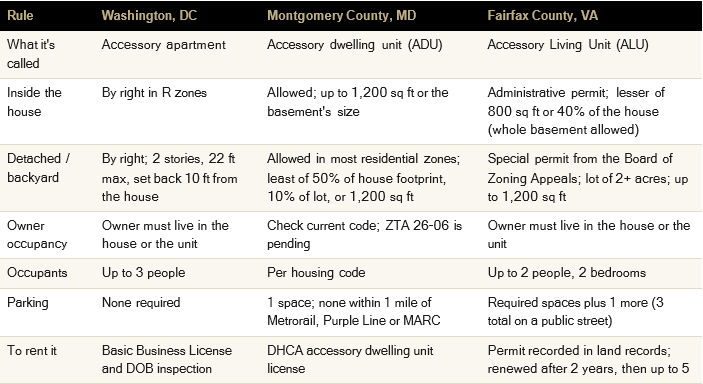
How do DC, Montgomery County and Fairfax County compare?
What does it take to add an ADU in Washington, DC?
DC treats an accessory apartment as part of the single-family use, so no separate Certificate of Occupancy is issued. You do need a building permit and inspection. The key rules from DOB’s Flats and Accessory Apartments Guide:
One accessory apartment per lot, inside the main house or in an accessory building, as a matter of right in R zones such as R-1, R-2 and R-3.
The owner lives in the main house or the apartment. No more than 3 people live in the apartment.
The apartment can be no more than 35% of the house’s gross floor area. The house must meet a minimum size (1,200 or 2,000 sq ft, depending on zone).
A backyard unit can be up to 2 stories and 22 feet tall. I ts footprint is the greater of 30% of the required rear yard or 450 sq ft. I t sits 10 ft from the house, needs alley or street access, and can’t have a roof deck.
In R-1A, R-1B and R-2, a new entrance can’t face the street. In R-3, a below-grade street-facing entrance is allowed, subject to historic review where applicable.
To rent the apartment, get a Basic Business License from DLCP and pass a DOB inspection.
What are Montgomery County’s ADU rules?
Montgomery County has allowed ADUs for years and dropped its spacing rule between units in 2019.
Under the rules in place before this year’s update:
Attached: up to 1,200 sq ft, or the full basement.
Detached: the least of 50% of the house’s footprint, 10% of the lot or 1,200 sq ft. Rear setback 12 ft.
Parking: one off-street space, with no space required within one mile of a Metrorail, Purple Line or MARC station.
Rental: an accessory dwelling unit license from the Department of Housing and Community Affairs
(DHCA), including an inspection.
What‘s changing: Maryland’s HB 1466/SB 891 took effect October 1, 2025 and required counties to adopt conforming rules by October 1, 2026. Montgomery’s ZTA 26-06 (introduced April 21, 2026; public hearing
June 9, 2026) would:
allow ADUs in every zone that permits a single-family house except industrial zones;
cap size at 75% of the main house;
align setbacks with regular accessory buildings;
exclude ADUs from density counts;
loosen parking rules.
Confirm the final adopted text with Montgomery Planning before you design.
What are Fairfax County’s Accessory Living Unit rules?
Fairfax’s rules took effect July 1, 2021. They use the term ALU because “ADU” means affordable dwelling unit in Fairfax.
Interior ALU: inside the house with interior access. The lesser of 800 sq ft or 40% of the house, or the whole basement as it existed on July 1, 2021. Approved by administrative permit.
Detached ALU: requires a special permit and public hearing at the Board of Zoning Appeals, a lot of at least 2 acres, and a maximum of 1,200 sq ft.
Owner occupancy; up to 2 people and 2 bedrooms; one ALU per lot, only with a single-family detached house.
Parking for the house plus one more space. A new entrance must be on the side or rear.
Permits are recorded in the land records before anyone moves in. They’re valid for 2 years, then can be extended up to 5 years at a time.
What‘s changing: In early 2026 Fairfax asked for public input on allowing detached units on lots under 2 acres, revisiting owner occupancy and the size cap, moving ALUs into the regular building-permit process, allowing interior units in townhouses, and lengthening renewal periods. Any change still has to go to the Planning Commission and Board of Supervisors.
What are the steps to add an ADU anywhere in the DMV?
- Check your zone, lot size and any HOA or historic district rules. HOA covenants can be stricter than county code.
- Choose the type. A basement or interior unit is usually fastest and cheapest. A detached unit needs more room and more approvals.
- Hire a designer who knows local code. Plan for egress windows, ceiling height, fire separation and utilities.
- Get the permit: DOB in DC, DPS in Montgomery County, or Fairfax LDS plus the ALU permit.
- License it before you rent: a DC Basic Business License, a Montgomery DHCA license, or a recorded Fairfax ALU permit.
- Talk to a lender and an appraiser early. Rental income from an ADU can affect financing and resale value.
Frequently asked questions
Can I build a backyard cottage in Fairfax County?
Only on a lot of at least 2 acres, with a special permit from the Board of Zoning Appeals. Fairfax is studying whether to allow them on smaller lots.
Do I have to live on the property?
In DC and Fairfax, yes: the owner must live in the main house or the unit. Check current Montgomery County rules after ZTA 26-06.
Do I need parking for an ADU in Montgomery County?
Usually one space, but none within one mile of a Metrorail, Purple Line or MARC station.
Can I rent out my DC basement apartment?
Yes, as an accessory apartment that meets the rules. You need a Basic Business License, which requires passing a DOB inspection.
How big can an ADU be?
DC: 35% of the house. Montgomery: up to 1,200 sq ft under prior rules, or 75% of the house under the pending ZTA. Fairfax: 800 sq ft or 40% inside the house, 1,200 sq ft detached.
Sources
DC Department of Buildings, Flats and Accessory Apartments Guide: dob.dc.gov
Montgomery Planning, ZTA 26-06 Accessory Residential Uses staff report (May 2026): montgomeryplanningboard.org
Montgomery County DHCA, accessory dwelling unit licensing: montgomerycountymd.gov
Fairfax County, Summary of Adopted Accessory Living Unit Provisions: fairfaxcounty.gov
Fairfax County, Accessory Living Unit (Administrative Permit): fairfaxcounty.gov
FFXnow, “Fairfax County seeks more feedback on options for accessory housing units” (Feb. 3, 2026): ffxnow.com



