

 Facebook
 X
 Pinterest
 Copy Link
Which office buildings qualify for conversion?
There is no single legal test. Whether a building works comes down to its physical shape, the deal economics and zoning. These rules of thumb are what developers and lenders look at first:
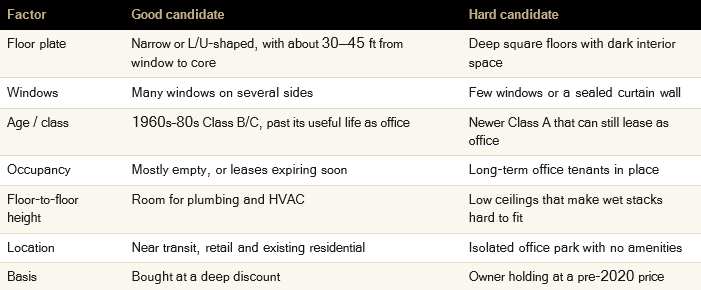
DC’s recent projects fit this profile. Aviator House in Dupont Circle is a 1972 eight-story building that was about 50% leased as office; it now has 157 apartments and was the first Housing in Downtown project to open. The Geneva in the Kalorama Triangle Historic District combines two 15-story mid-century buildings (604,000 sf) into 532 apartments, including 60 affordable units, at a cost of $575 million. 1255 23rd St NW, a 1982 building in the West End, is planned for about 323 units.
How does DC’s Housing in Downtown program work?
Eligible area: downtown, as defined in the Comeback Plan, expanded in October 2025. Lots on either side of a boundary street qualify.
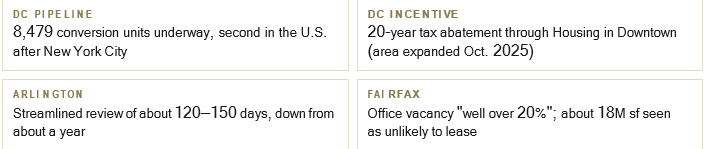
Benefit: a 20-year residential property tax abatement starting the year the Certificate of Occupancy is issued. Certified projects are also exempt from TOPA on the first sale within 10 years.
Requirements: a change of use with at least 10 units. Either 10% of units affordable at 60% MFI, or 18% at 80% MFI. A CBE agreement and First Source compliance during operations.
Funding caps: $2.5M (FY24—26), $5M (FY27), $41M (FY28), then 4% growth per year. Awards are competitive, scored on financial need and the Mayor’s downtown goals.
The program caps are small in the first years. Most of the money arrives in FY28, which is why many DC projects are lining up to open around then.
How do Northern Virginia jurisdictions handle office conversions?
Arlington County
Arlington adopted its policy and zoning change in November 2024. Before, changing more than 5% of a building’s use took a major site plan amendment, which was costly and took about a year. The streamlined path takes about 120-150 days for buildings that qualify. To qualify, the building has to:
have been occupied for at least five years;
be at least 50% office;
convert more than half its office space to a use the zoning allows.
Rosslyn and Ballston already have projects moving.
Fairfax County
Fairfax adopted an office repurposing policy in 2018 to speed up plan amendments. In 2026, Chairman Jeff McKay called for “aggressive” action. The county launched planning studies in Tysons and Reston East after owners asked to add housing. Industry estimates put about 10% of the county’s office stock, roughly 18 million sf, at little chance of leasing again. One example in progress is 2990 Telestar Court in Merrifield, a former Inova building being converted to affordable housing. Fairfax’s Plan Forward comprehensive plan update (Phase 2 draft released October 2026) is the next place to watch for policy changes.
The key difference
DC pays for conversions with tax abatement. Northern Virginia mostly saves owners time with faster approvals. In Northern Virginia, the purchase price has to make the project work without a tax break.
What does this mean for owners, investors and buyers?
Office owners: Get a feasibility study on floor depth, windows and plumbing before you assume a building is “conversion-ready.” Many aren’t, and those may be better candidates for demolition or a different use.
Investors: In DC, model the abatement and the affordable rents together. In Northern Virginia, underwrite to a low basis and the shorter approval timeline.
Renters and buyers: Expect new rental supply downtown, in Dupont Circle and in the West End, and over time in Rosslyn, Ballston, Tysons and Reston. Converted units often come with concessions while they lease up.
Frequently asked questions
Does DC give tax breaks for converting offices to apartments?
Yes. Housing in Downtown offers a 20-year abatement for qualifying projects of 10+ units with affordable set-asides.
Does Northern Virginia offer a similar tax break?
Not at the same scale. Arlington’s main tool is a streamlined approval of about 120—150 days, and Fairfax relies on plan amendments and planning studies.
Why can‘t every empty office become housing?
Deep floors leave interior rooms without windows, plumbing is expensive to add, and some owners can’t sell at a price that makes conversion work.
How many conversion units are underway in DC?
About 8,479 as of early 2026, second nationally after New York City.
Which DC conversion is the largest?
The Geneva: 532 apartments in two former office towers, which broke ground in January 2026.
Sources
DC DMPED, Housing in Downtown program (Oct. 2025): dmped.dc.gov
Facilities Dive, recent office-to-residential conversions in DC: facilitiesdive.com
Mayor Bowser, The Geneva groundbreaking: mayor.dc.gov
CoStar, Arlington streamlines office conversions: costar.com
FFXnow, “Fairfax County leaders seek creativity to reduce excess office building stock” (June 18, 2026): ffxnow.com
Holland & Knight, Fairfax County Phase 2 Plan Forward draft (Oct. 2026): hklaw.com



